
The Sacred Observers of Ancient Greece and Their Many Roles

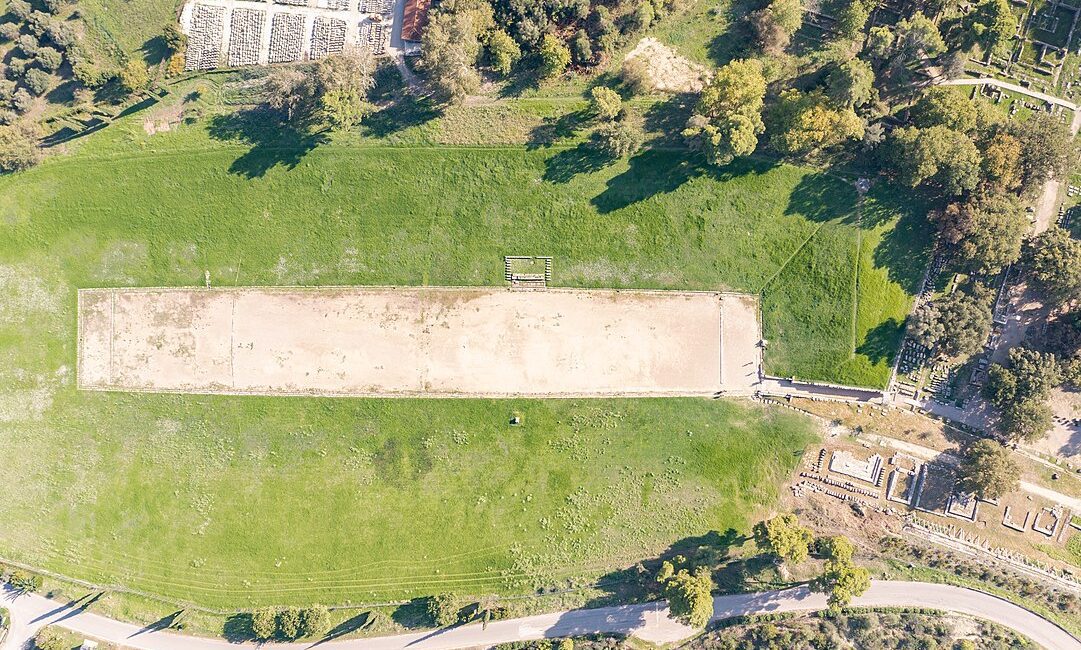
Ancient Greek sacred observers were delegates who were sent to religious festivals and athletic games to observe and represent their city. Top down aerial of the stadium in Olympia, Greece. Credit: dronepicr / Wikimedia Commons / CC BY 2.0
For at least a thousand years, the cities of Ancient Greece sent sacred observers to other cities to monitor religious festivals and athletic games, acting as delegates of their homeland—a practice central to cultural and civic life.
These sacred observers were called theōroi (θεωροί), literally “observers,” while a delegation of such individuals—or the action of participating in one—was known as theōriā (θεωρία). Their functions were diverse, and their position was highly esteemed, as they served as official envoys representing their city.
A network of sacred observers extended across Greece, with missions to sanctuaries and stadiums where games were held. Their role combined religious and civic duties, reflecting the seamless integration of religion and public life in Ancient Greece.
These missions blended diplomacy, religious observance, and cultural affirmation. Communication between communities through the sacred observers helped maintain a shared Hellenic identity across the Greek world. The institution of sacred observers developed in a society where religion influenced nearly every aspect of life.
Festivals were not merely celebrations; they were expressions of civic pride, contests for prestige, and opportunities for inter-polis networking. Each festival honored a particular deity, often the patron god of the hosting polis (city). The presence of visitors from other regions symbolized recognition of both the deity’s importance and the host city’s influence. To manage these relationships formally, sacred observers were dispatched throughout Ancient Greece. Their responsibilities varied by era and region but typically included announcing festivals, representing their home city’s devotion, performing sacrifices, and strengthening diplomatic ties.
Herodotus’ description of sacred observers in Ancient Greece
Herodotus described the duties of sacred observers in Ancient Greece, noting that they were responsible for observing sacred rites and competitions, making dedications, and occasionally acting as representatives of their city-state. The historian himself attended festivals and games, contrasting various cultural customs to highlight their unique significance. He also observed that sacred observers were often accompanied by an entourage of other citizens who participated in the rituals and festivities alongside them.
Specifically, Herodotus wrote that city-states such as Chios would send a hundred young men as official sacred observers to Delphi. These observers frequently traveled with other citizens who joined them to partake in the religious ceremonies and celebrations. Theōroi made offerings on behalf of their city. For instance, Croesus sent Lydian representatives to the oracles, who served both as observers and presenters of gifts, such as gold shields and spears.
Through his accounts, Herodotus illustrated the cultural relativity of practices considered “normal,” such as the contrasting customs of the Greeks and the Callatian Indians regarding the treatment of the dead. His critical and observational approach to religion, both within and outside Greece, suggests a degree of skepticism about traditional Greek beliefs concerning the gods.
Practical issues of traveling for sacred observers in Ancient Greece
Herodotus notes how sacred observers moved between Greek cities, whether during times of crisis or celebration. In one episode, he describes officials from Delphi who traveled widely to seek support during the Persian Wars. The historian speaks of them with respect, emphasizing the religious weight of their mission: “They went forth as servants of the god, bearing his commands to all the peoples of Greece.” This statement captures the unique status of sacred observers—they were political figures, yet they spoke under divine authority, a combination that conferred an aura of neutrality and respectability often absent in ordinary diplomats.
The journeys of theōroi were not merely religious obligations; they also served as instruments of political signaling. When a city announced a major festival—such as the Olympic, Pythian, Nemean, or Isthmian Games—sacred observers were sent throughout the Greek world to proclaim the spondai, a sacred truce. This truce protected athletes and pilgrims traveling to the festival and functioned as a moment of pan-Hellenic unity, reminding rival states that shared cultural bonds could transcend conflicts. As Thucydides later observed, “Even amidst war, the gods must have their due.” The theōroi were the agents who made this principle practical.
Some modern historians view the sacred truce as an early form of international law or humanitarian principle. Paul Cartledge notes that the sacred observers of Ancient Greece carried not only messages but also the promise of peace, however temporary, serving as reminders of a civilization that valued shared ritual as a political instrument.
Dignity and moral conduct
Inscriptions from prominent cities such as Athens, Delphi, and Epidaurus provide valuable information about sacred observers and their travels. These stone records often list the names of theōroi, their missions, and the decrees authorizing their journeys. A recurring theme is the emphasis on dignity and moral conduct.
Cities expected their sacred observers to exemplify virtuous behavior because they represented not only civic authority but also the community’s reverence for the gods. One inscription from the island of Tenos praises a theoros for his “uprightness, his devotion to the gods, and his goodwill toward all cities.” This blend of piety, integrity, and diplomatic courtesy captures the essence of the position.
To comprehend the significance of sacred observers, it is helpful to consider the role of personal communication in the ancient world. Theōroi were the official bearers of invitations and announcements. They proclaimed festival dates and ensured that attendees received hospitality. Their presence elevated a regional gathering into a larger, more prestigious event. Host communities treated them with ceremonial respect, offering meals, lodging, and occasionally gifts. Hospitality (xenia) was not merely a kindness; it was a legal and religious obligation, positioning the theōroi as both guests and dignitaries.
The role of sacred observers was especially prominent in connection with major pan-Hellenic sanctuaries. At Delphi, for instance, the sacred delegates of the Delphic Amphictyony, an ancient religious league, coordinated their missions to help maintain political balance in Central Greece. In this way, the theōroi contributed to a wider diplomatic network that could influence decision-making during periods of conflict or uncertainty. When Philip II of Macedon rose to power, much of his early legitimacy in Greek eyes came from his recognized role within the Delphic religious system, a system whose stability was supported in part by the presence and authority of sacred observers.
The necessity of theōroi
The tasks of the sacred observers were not always peaceful. Although they traveled under the protection of sacred custom, their missions sometimes placed them in tense situations. If a city refused to recognize a festival’s truce or denied a sacred delegate proper hospitality, it risked both religious offense and political repercussions.
Certain cities even utilized the presence of sacred observers as a political tool, honoring them lavishly to attract alliances or treating them coldly to signal disapproval. The traveler Pausanias, writing many centuries later, recounts an instance in which officials sent from Elis to Sparta were dismissed due to tensions between the two states. Pausanias observed, “The gods’ messengers are not always welcomed by the hearts of men,” a reminder that sacred authority did not always overcome political rivalry.
Despite such occasional complications, the institution of sacred observers endured for centuries in Ancient Greece because it proved highly efficient, providing structure for interactions between competing communities and conferring religious legitimacy on diplomatic activities. Sacred envoys also served as cultural ambassadors, sharing news, exchanging ideas, and witnessing the achievements of other cities. Their presence reinforced the sense that all Greek cities, despite their differences, were participants in a common cultural world.
Certain festivals were unimaginable without the theōroi. The Olympic Games, for instance, relied on sacred observers to guarantee safe passage for competitors and spectators. Without their proclamation of the sacred truce, these festivals might have been disrupted by the endemic warfare of the Greek world.
The noble tradition of sacred delegates in Ancient Greece
Modern interpreters often celebrate the function of sacred observers as a noble tradition. The classicist Werner Jaeger wrote: “The sacred envoy bears the message of peace, for the Greeks believed that the glory of the gods stood above the ambitions of any single city.” Jaeger’s perspective emphasizes the aspirational quality of Greek culture—a society frequently torn by conflict yet capable of articulating ideals that transcended violence.
Sacred observers remind us that, for the Greeks, religion was inseparable from public life. Civic identity was shaped by ritual, and diplomacy often drew its authority from sacred tradition. When a sacred observer traveled throughout Ancient Greece, he acted as a bridge, connecting the political community with the divine and linking the customs of his home city with those he visited. In a world full of uncertainties, this role provided stability and continuity.
The missions of sacred observers helped maintain the rhythm of festival life, ensured the observance of sacred truces, and fostered communication between distant communities. Their work contributed to a collective identity that bound the Greek world together. As an ancient Delphic saying preserved by Plutarch notes, “Through those who journey in the god’s name, harmony travels farther than discord.”
A list of sacred Athenian observers at Delphi
A surviving list of Athenian theōroi from the second Pythais, the Athenian sacred observers’ mission to Delphi, dates to 128/7 BC. This list was inscribed on a single block in the southern wall of the Athenian Treasury at Delphi, immediately below the list of sacred delegates from the first Pythais of 138/7 BC.
The inscription for the 128/7 BC Pythais reads:
For Good Fortune, in the archonship of Pyrrhos at Delphi, and of Dionysios after Lykiskos in Athens (128/7), the following were dispatched as sacred delegates by the People of the Athenians to help conduct the Pythais:
Demainetos son of Demeas
Eudemos son of Sarapion, by birth son of Gorgippos
Chares son of Chares, the younger
Ptolemaios son of Euboulos
Dionysios son of Euboulos
Rhadamanthys son of Attinas
Sostratos son of Alexandros
Xenon son of Philanthes
Lysias son of Pyrrhos
This list illustrates the meticulous recording of sacred observers in Ancient Greece and highlights the civic and religious significance attributed to their missions. The thorough documentation ensured accountability and preserved the memory of those who represented Athens in one of the most significant religious centers of the Geek world.


0 Comments