
The Greek and Roman origins of Christmas traditions

From Pagan Winter Festivals to Christian Celebrations
Holidays and rituals have always been universal aspects of the human experience, almost inextricably linked to being part of a community, an organised society, and, eventually, a culture.
In the Western world, calendars and festive days have for many centuries been based on Christian chronology and observance. But many of these traditions can trace their roots back to Ancient Greece and Rome. This is evidenced in many ritual practices, including Christmas customs.
Winter solstice
It is widely accepted that Christianity incorporated pagan festivals, first remolding their content to fit the new religious context. Christmas, in particular, is believed by most researchers to have originated as a Christian substitute for pagan celebrations of the winter solstice; the birth of Christ is not given an exact date in the Bible, and, based on the Nativity’s descriptions, it would in fact be highly unlikely that it took place in the middle of winter.
It is thus believed that the date of 25 December was chosen to coincide with the date of the winter solstice on the Roman calendar. There have, in fact, been speculations that the exact date was chosen because it coincided with a previous Roman festival called the Natalis Solis Invicti, meaning the birthday of the Unconquered Sun. Sol Invictus was the official sun god of the later Roman Empire; his cult was made an official religion by the Roman emperor Aurelian on 25 December AD 274. It is worth noting that, in the Gospels, Christ’s figure is often likened to the sun, for example in the hymn of Zechariah (Luke 1:78, 79) and as the “light that shines in the darkness” (John 1:5).
Kronia and Saturnalia
Other festivals believed to have had a direct influence on the celebrations of Christmas and the New Year are the Greek Kronia and the Roman Saturnalia.
Saturnalia by Antoine-François Callet (detail)
Kronia: The Greek Festival of Equality and Harvest
The ancient Athenian Kronia, held on the 12th of Hekatombaion (midsummer), honored Kronos, god of agriculture and the harvest. This one-day public holiday featured a remarkable social inversion: slaves dined alongside masters, sharing the fruits of their labor in a spirit of equality. Offerings included fruit and bread.
Saturnalia: Rome’s Joyful Winter Carnival
Directly inspired by Kronia, the Roman Saturnalia—dedicated to Saturn (Kronos’ equivalent)—began on December 17 and later expanded to seven days ending December 23. Tied to winter sowing, it was a time of merrymaking, drinking, gift-giving (candles, wax fruits, figurines), and role reversals where slaves were freed from work and joined feasts.
Homes were adorned with evergreen boughs and mistletoe, symbols of eternal life, love, and peace—seen as precursors to Christmas wreaths, mistletoe kissing traditions, and even the Christmas tree. A mock king (saturnalicius princeps) often presided over the chaos, a custom echoed in the Epiphany king cake tradition (with its hidden figurine crowning the finder).
Dionysus: The Dying-and-Rising God of Wine
The Greek god Dionysus (Roman Bacchus), born of Zeus and a mortal mother, experienced death (dismemberment by the Titans) and resurrection—parallels drawn by scholars to those of Jesus Christ. Known for wine, festivity, and theater, his epithets include “Saviour” and “Deliverer from sorrow.” The miracle of turning water into wine echoes Gospel themes.
His ancient Rural Dionysia in Poseideon (mid-December to early January, around the winter solstice) celebrated vines with bread, fruit offerings, wine-drinking, singing, and dancing—allowing revelers to attend multiple local festivals.
Pyanopsia: Autumn Thanks and Decorated Branches
The Athenian Pyanopsia, held in Pyanepsion (October/November) for Apollo, god of light and healing, involved offering a rich bean stew and the eiresione—an olive or laurel branch wrapped in wool, adorned with fruits, pastries, and drizzled with wine. Carried in procession to Apollo’s temple or hung on home doors, it’s considered a forerunner of Christmas wreaths and decorative branches.
The Triumph of Bacchus, Diego Velázquez (Museo del Prado)
Santa Claus and Saint Basil: Gift-Givers Rooted in Greek Saints
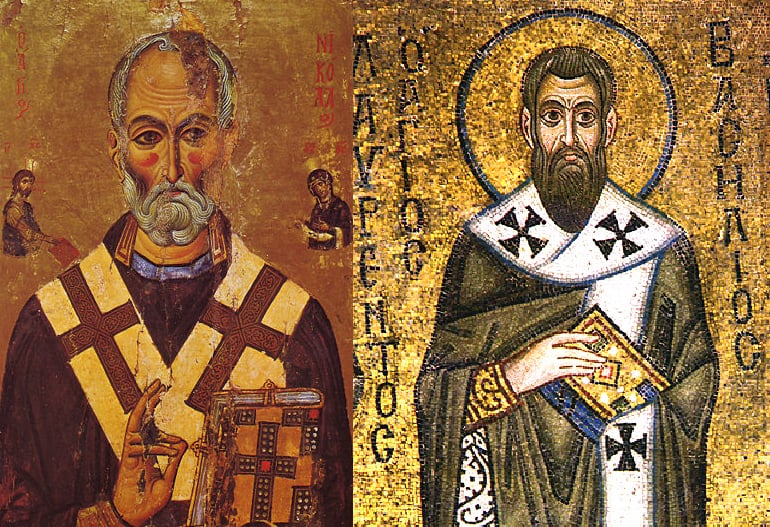
The jolly, gift-bearing figure of Santa Claus dominates global Christmas folklore, blending traditions like Britain’s Father Christmas and Germanic myths of Wodan. At its core, however, lies Saint Nicholas—a Greek bishop whose name evolved into “Santa Claus” via the Dutch “Sinterklaas.”
Saint Nicholas of Myra (270–343 CE), born in Asia Minor (modern Turkey), was a miracle-working bishop famed for secret acts of generosity. One legendary tale tells of him anonymously providing gold dowries for three impoverished sisters by tossing sacks of coins through their window—saving them from destitution.
In Greek Orthodox tradition, the gift-bringer is Saint Basil the Great (Agios Vasilios), whose feast day is New Year’s Day (January 1). Basil of Caesarea (330–379 CE), a prominent theologian and bishop in Cappadocia, was renowned for his charity: he built hospitals, fed the poor during famines, and donated his inheritance to those in need.
Greek families mark the occasion with vasilopita, a sweet bread (despite the name “pita”) baked with a hidden coin. The person who finds it is blessed with good luck for the year—a custom echoing the ancient Saturnalia mock king and the Epiphany king cake.
From ancient role reversals to saintly generosity, these traditions remind us how Greek heritage continues to shape holiday magic. Chronia Polla for a blessed New Year! 🇬🇷✨
The Real Santa Claus Was Greek: How Saint Nicholas of Myra Became the World’s Most Famous Gift-Giver
Tags:ancient Greece, apokries, Christmas traditions, Die Natalis Solis Invicti, Dionysus, Hekatombaion, Jesus Christ, Kronia and Saturnalia, Pyanopsia, Rome, Saint Basil, Saint Nicholas, Santa Claus, Unconquered Sun, Winter solstice
GCT Team
This article was researched and written by a GCT team member.


0 Comments