
Roman-Era Greek Inscription Stele Discovered in Muğla

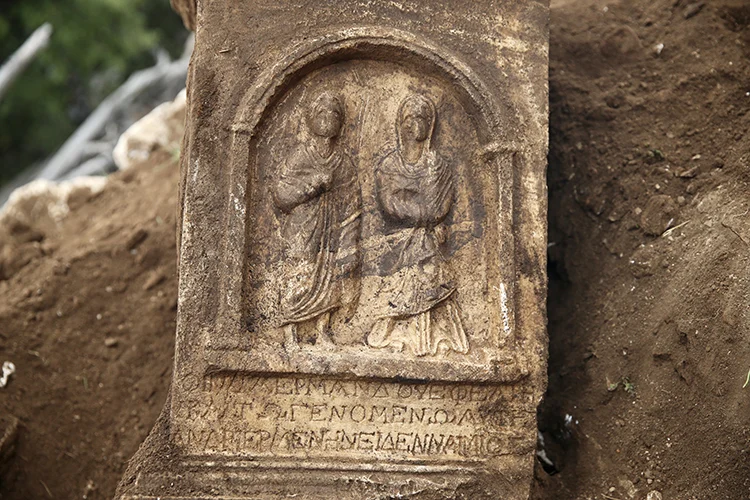
A shepherd in Seydikemer, Muğla Province, has discovered a Roman-era funerary stele bearing Greek inscriptions and reliefs of a married couple, dating to the 1st–3rd century CE.
Experts believe the monument originates from the ancient Lycian city of Kadyanda (Cadyanda), confirming the strong Greek-speaking Hellenistic culture that persisted in southwestern Türkiye under Roman rule. The stele is now undergoing conservation at Fethiye Museum for public display.
The monument, which dates to the 1st–3rd centuries CE, confirms the strong Hellenistic cultural legacy in the region and points to the existence of a Greek-speaking community in what was once part of ancient Lycia.
A Monument Unearthed by Coincidence
While grazing goats on the forested slopes of Kayacık, the shepherd noticed an unusually shaped stone protruding from the soil. Recognizing its historical significance, he immediately informed the Fethiye Museum Directorate. Experts confirmed the artifact’s authenticity and, given the risk of looting in the remote location, temporarily reburied it under camera surveillance until a professional recovery operation could be mounted.
A Difficult Rescue in Rugged Terrain
Reaching the site required a 45-minute trek from the nearest road. After careful excavation, the large stele was wrapped for protection and carried by hand across rocky, steep terrain for several hours before being loaded onto a vehicle. The successful operation safeguarded a monument that had lain undisturbed for nearly two millennia.
Greek Inscriptions and Rich Iconography
The stele features a finely carved relief on its front face depicting a married couple standing side by side, dressed in typical Roman-period attire. A wreath motif on one side symbolizes honor and high social standing. Most significantly, the monument bears a well-preserved Greek inscription containing biographical details of the deceased—a clear indicator that the local population, even under Roman rule, continued to use Greek as the language of commemoration and public expression.
Archaeologist Ahmet Meke notes that such Greek-language funerary stelai are characteristic of Hellenistic and Roman-period towns across southwestern Anatolia, where Greek culture remained dominant long after the Roman conquest. The discovery strongly suggests the stele originated from a nearby ancient settlement with deep Greek cultural and linguistic roots.
On Its Way to Public Display
Conservation and restoration work is now underway at the Fethiye Museum. Once completed, the stele will be placed on permanent exhibition, offering visitors a tangible link to the Greek-speaking communities of Roman Lycia and highlighting the vital role ordinary citizens continue to play in protecting Türkiye’s shared Hellenistic and Roman heritage.


0 Comments