
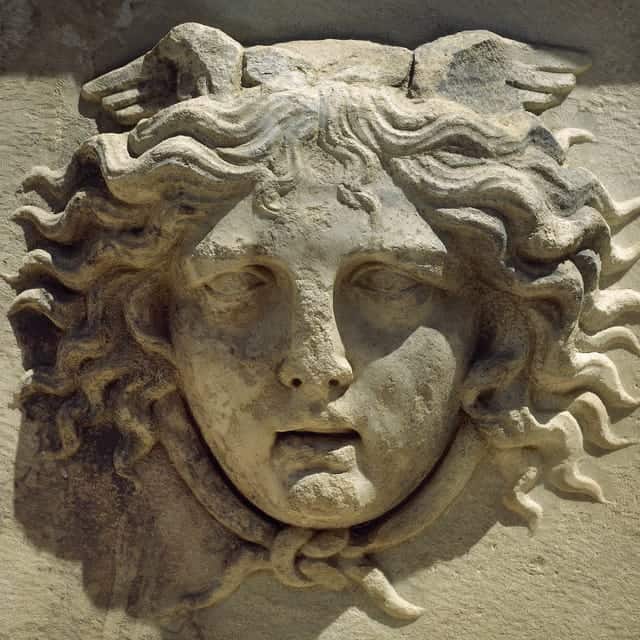
Rare ‘Smiling Medusa’ Unearthed in Ancient City Founded by Greek Queen Amastris

A remarkable archaeological discovery in northern Türkiye has revealed a unique depiction of Medusa from Greek mythology – not with her usual terrifying glare, but with a gentle, childlike smile.
Archaeologists excavating the ancient city of Amastris (modern-day Amasra on the Black Sea coast) have uncovered a marble ceiling panel featuring a smiling Medusa, a stark contrast to the fearsome Gorgon known for turning onlookers to stone.
The find was made during ongoing excavations of a monumental Roman-era stoa (columned gallery) in the city’s ancient forum, part of Turkey’s “Heritage for the Future” project led by Prof. Dr. Fatma Bağdatlı Çam from Bartın University.
“Our Medusa was made just like an Eros, like the face of a very small child and in a smiling pose,” Prof. Çam explained.
While traditional depictions of Medusa show her with snake hair and a menacing expression – often used as an apotropaic symbol to ward off evil – this version is interpreted as representing peace and prosperity during the city’s prosperous Roman period.
Amastris was originally founded in the Hellenistic era by Queen Amastris, a Greek noblewoman and niece of Darius III, who named the city after herself. It later flourished under Roman rule, becoming a key centre for trade and social life.
The excavation has so far uncovered tall marble columns (some up to 30 feet high), architectural blocks, and ceiling coffers over a 30,000-square-foot area. Several columns have already been re-erected as part of efforts to reconstruct the stoa and open the site to tourists.
“We are very excited,” Prof. Çam said. “We want the area to be brought to tourism as soon as possible, and we want domestic and foreign tourists to see and watch the ancient city gradually rise to its feet.”
This smiling Medusa adds to previous finds at the site, including statues linked to Greek and Roman mythology, further highlighting the city’s rich Hellenistic and Roman heritage with deep ties to ancient Greek culture.
The discovery challenges conventional views of Medusa iconography and offers fresh insights into how mythological figures were adapted in different cultural contexts during antiquity.
Tags:
Amasra, Amastris, ancient discoveries, ancient Greece, archaeology, Bartın University, Black Sea coast, Fatma Bağdatlı Çam, Greek heritage, Greek mythology, Hellenistic history, Medusa, Queen Amastris, Roman stoa, smiling Medusa, Türkiye archaeology


0 Comments