
Modern Greek at a crossroads: Challenges meet new opportunities

Walk into almost any Greek -language classroom in Victoria, day school, after-hours, community setting, and you’ll hear a mix of pride and pressure. Pride, because Greek carries stories, faith, migration, humour, music, philosophy, and a living community identity. Pressure because the conditions around language learning have shifted – there is less time, less space, fewer resources, fewer specialist teachers, and students arriving with vastly different learning needs and expectations.
Recent data confirms what teachers have known for years. According to the Victorian Curriculum and Assessment Authority (VCAA), VCE Greek enrolments have generally declined across all units since 2019. There have been minor fluctuations and brief recoveries, but the overall trend is downward, both in student numbers and in the number of providers (schools) offering Modern Greek as a subject.
Modern Greek enrolments plummet and the struggle to keep the Greek alive
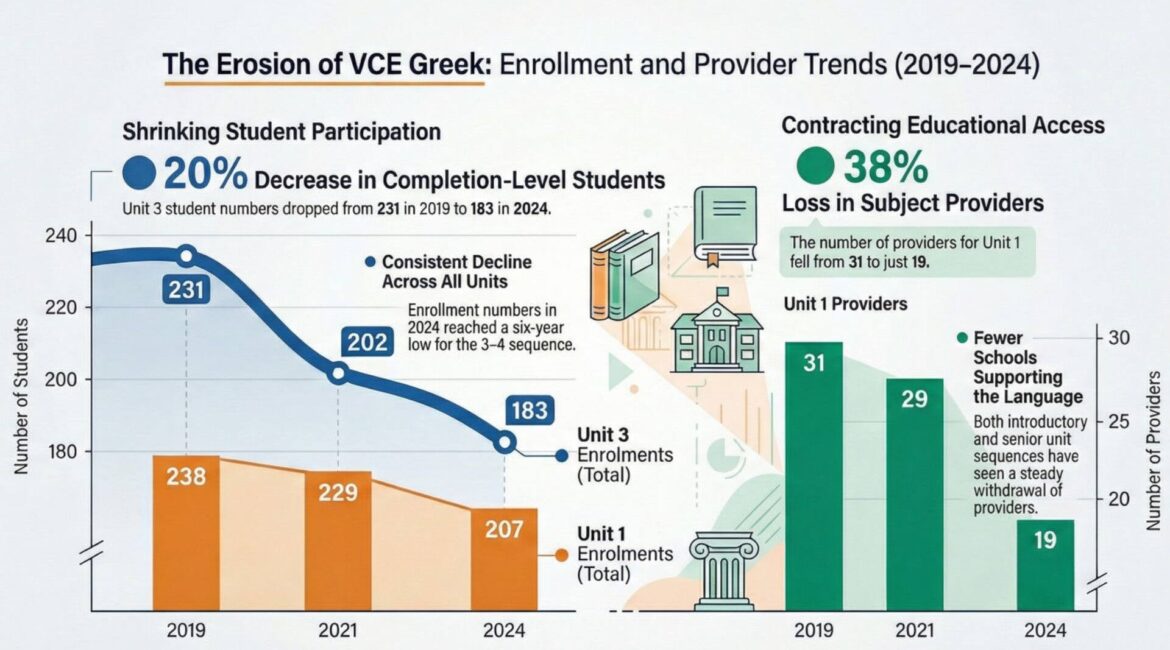
Modern Greek in Victorian schools is facing a worrying decline. Enrolments in senior Units 3 and 4 have fallen by roughly 21 per cent over the past five years, dropping below 200 students for the first time in 2023. From a high of 231 students in 2019, numbers slipped to 210 in 2020 and 202/201 in 2021, briefly recovered to 210/207 in 2022, before plunging again to 197/196 in 2023. The decline continued into 2024, with just 183 students in Unit 3 and 181 in Unit 4.
Junior Units 1 and 2 have followed a similar trajectory. After reaching 238 and 237 students in 2019, enrolments fell to 220 and 217 in 2020, rose slightly to 229 and 228 in 2021, then dipped to 222 and 207 in 2022. The lowest point came in 2023 with 197 students in both units, before a modest rebound in 2024 to 207 and 202.
The drop in student numbers goes hand in hand with a steady reduction in schools offering Modern Greek. Unit 1 providers have fallen from 31 in 2019 to just 19 in 2024, while Unit 3 providers have dropped from 28 to 20. For families, this is more than a school issue—it is a continuity problem. Fewer providers mean fewer opportunities for students to study the language, pathways break, and Modern Greek becomes increasingly easy to drop “next year.” Community advocates warn that if the trend continues, the language risks becoming increasingly rare, putting a vital part of Greek Australian cultural heritage at risk.
Turning challenges to opportunities in era of AI
So, where does Artificial Intelligence (AI) fit into this? Not as a miracle cure. Not as a replacement for teachers. And not as a shortcut that turns language into a button-click translation exercise.
AI is best understood as a leverage tool: it multiplies the impact of a good teacher, expands students’ practice time, and strengthens the home-school partnership. Used wisely, it helps us convert today’s pain points into a modern, scalable model for Greek learning, one that matches the reality of 2026 classrooms.
Teacher crisis and amplification
Greek programs often rely on a small number of specialists—and when one teacher leaves, the program wobbles. While AI cannot be a teacher, but may can reduce the repetitive workload. It can generate differentiated activities, build listening scripts, create retrieval practice, and draft formative assessments. AI can free teachers to do what only humans can do well, build relationships, provide cultural mentoring, motivate, and offer high-quality feedback.
Balance in a class of mixed levels through multiple entry points
One class may include indigenous heritage speakers, as well as beginners, and late starters all in the same room. AI can create an environment where the same theme is taught across different entry points. This means one shared topic, with varying complexity, short, patterned sentences for beginners, richer registers for advanced learners, and scaffolded literacy support where needed.
Table: The Erosion of VCE Greek: Enrolment and Provider Trends (2019-2024)
Multiple classes and consistency across cohorts
When a program spans Years 7-10 plus VCE, maintaining consistency becomes difficult, especially when there are staffing changes. AI can make it easier to maintain a shared spine of core themes, grammar progressions, and task types, while still allowing each teacher to teach in their own voice.
Rapid creation of bespoke resources
Greek teachers have lived with the resource gap for decades such as, limited age-appropriate texts, insufficient Australian Greek contexts, and constant adaptation. AI can assist by creating what is missing and that is locally based dialogues, bilingual support, mini-readers, illustrated storybooks, animations, role-plays, and culturally authentic scenarios, then repurposes them into quizzes, flashcards, and interactive tasks.
Student engagement through interactivity, voice, and choice
Engagement is not about making Greek easy. It’s about breathing life in it. AI-supported tools add student voice recording, instant playback, pronunciation practice, and interactive missions. For example you can use AI and ask it to order a Greek salad or, ask for directions or to introduce your family. When learners hear themselves improving week by week, both confidence and effort increase.
AI as home support as a bridge not a burden
Not every household can help with Greek homework, especially in multilingual families. AI can generate short home routines: 5-minute speaking prompts, parent-friendly phrase lists, and “what to practise this week” scripts. Done well, this reduces stress and builds a language culture at home.
Time and space with AI micro-learning
Greek competes with sport, homework, devices, fatigue, and timetable crowding. AI enables micro-learning: short, targeted bursts that address a student’s gaps. Ten minutes of targeted practice beats an hour of generic revision, especially when the learning environment is fragmented.
Classroom realities that changed my thinking
There’s a line attributed to Heraclitus, “One never steps into the same river twice.” It’s a reminder that the conditions around us change, whether we like it or not. Greek education is already standing in a different river, it has different student cohorts, family structures, time pressures, literacy profiles, and expectations. The question is whether we respond with yesterday’s tools or with smart solutions that match today’s reality.
On the first day of school after the summer holidays, a Year 10 student walked into my office and greeted me in Greek. He wasn’t of Greek background. He had only been learning Greek for 16 weeks. Yet, he smiled and said, “Sir, I can still communicate in Greek and read. I remembered what you taught us.” Looking back, all I did was set up a fully scaffolded, multimedia, interactive environment using AI and make it available 24/7. In class, students could advance at their own pace after whole-class explicit instruction and gradual release of responsibility.
What mattered wasn’t that he had memorised a list of words and phrases. What mattered was that the language had stayed usable in his mind. Through AI, I had been able to build a course with multiple entry points and clear pathways: students could learn at their own pace, practise speaking daily with classmates, and rehearse dialogues with a “virtual friend” when a real speaking partner wasn’t available. The outcome was not a gimmick; it was sustained communicative confidence. And confidence is the currency that keeps students enrolled and learning Greek.
On another occasion, a young father in a mixed marriage approached me about his six-year-old daughter. He wanted her to continue learning Greek but felt disheartened: the school had placed her in a multi-age, mixed-ability class spanning Kinder, Prep, and Year 1. Although the teacher was doing her best with the resources available, the structure made success feel almost impossible because it relied on the very solutions that often created persistent problems: one-size-fits-all texts, one pace, one level, regardless of students’ unique needs, ages, and lived experiences.
In this case, my advice was to use AI to individualise the child’s experience; 15 minutes a day, while the young student continued attending school for what it does best: social development, cultural experiences, belonging, episodic memory, and learning “Greek for life”, not just for a worksheet or an exam. The language component became targeted, achievable, and consistent. And consistency is what families need to see if we want enrolments to grow and be sustained rather than drift away.
Time to stop the decline
The VCAA trend, mentioned earlier in this article, is a warning, but it’s also an invitation. If enrolments are declining and providers are shrinking, then doing “more of the same” will not protect Greek. The river has changed. Modern language providers need a shared, smart strategy that optimises learning spaces and expands access for diverse learner populations. This approach should integrate teacher-led AI resources that reduce workload while improving consistency, offer multiple entry points so beginner and heritage learners can thrive together, and provide daily speaking practice supported by safe, structured AI tools. Beyond the classroom, home micro-routines enable families to sustain their learning journey. Crucially, the modern value proposition positions Greek not merely as a subject to master but as a vehicle for communication, cultural understanding, and future capability.
The choice is not between AI and Greek.It’s Greek taught with the intelligence, creativity, and scale this era demands.
*Dr Nikolaos Bogiannidis Digital Learning Specialist at St John’s College, Preston.


0 Comments