
Day trip to Travnik and Jajce in central Bosnia

Central Bosnia is a region of dramatic mountainous landscapes, medieval towns and a rich Ottoman legacy. I visited this stunning region as a day trip and discovered a land of verdant forests, crystalline lakes, gushing waterfalls and towns steeped in history. This amazing day trip from Sarajevo to central Bosnia turned out to be one of the highlights of my one-week stay in Bosnia and Herzegovina.
Pliva Waterfall in Jajce in central Bosnia.
In Sarajevo, a short stroll from my accommodation in the old town, I met my guide, a friendly and knowledgeable chap from Meet Bosnia Tours, and bundled ourselves into the van along with several other guests. We drove in a northwesterly direction through lush forests and lofty mountains. Bosnia never stops impressing with its natural beauty!
Gorgeous scenery along the way.
Travnik
Our first stop, after a 1.5 hour drive, was Travnik (map), an atmospheric town that was once the administrative centre of Bosnia under Ottoman rule.
The view of Trasnik from the fortress.
In the 17th – 19th centuries, Travnik served as the capital of the Ottoman province of Bosnia. The seat of the viziers, Travnik played an important role in shaping much of the region’s administrative and cultural life. Here are the top attractions in Travnik which we visited:
Plava Voda
Our first stop was at the edge of the old town: Plava Voda or Blue Water river. It’s a lovely part of the town, with gentle cascades and riverside cafés. We stopped to have a look at a historic madrassa (Islamic school) as well as an ancient cemetery.
Plava Voda
I walked along the cascades and the trout-filled ponds before stopping at one of the riverside cafés for a Bosnian coffee.
Trout ponds
Travnik Fortress
Our next stop was the Travnik Fortress, a medieval fort overlooking the town. We had beautiful panoramic views from the fort, and got to learn more about Travnik’s layered history, from its medieval beginnings to later centuries under Ottoman governance.
Fortress
View of Travnik from the fortress.
Carpet weavers at the fortress
Travnik Old Town
We then made our way down to the atmospheric old town, where we visited Šarena Džamija (Painted Mosque). The 16th century Painted Mosque dazzled with its vibrantly decorated interior, a striking example of Ottoman architecture in Bosnia.
Painted Mosque
Interior of the mosque
We roamed around the old town, with its Ottoman-era čaršija (bazaar), clock towers and historic mosques and churches. Travnik is also famous as the birthplace of Nobel Prize-winning author Ivo Andrić – there’s a modest museum that documents his life and works.
We stopped for lunch at Ćevabdžinica Hari, a BBQ restaurant that’s famous for its ćevapi (Bosnian minced meat fingers) and grilled chicken.
Lunch at Ćevabdžinica Hari
After lunch, I made one more stop, a charming café under the Painted Mosque. I ordered a Bosnian coffee and started chatting with the proprietor – I soon learned that he’d lived in Malaysia (where I was born) for several years and still spoke Malay! What a small world!
Vezirov Dućan café
He watched me as I poured the coffee and smiled, “That’s perfect – just like a local!” Clearly, my coffee-pouring lesson the day before (in Sarajevo) had paid off and I felt very pleased with myself.
Pliva Lakes
Our Central Bosnia day trip continued from Travnik with an hour+ drive northwestwards to Jajce. Before reaching the old town, we visited the serene Pliva Lakes. The twin lakes glistened, in shades of jade and emerald, in the afternoon sun.
Pliva Lakes
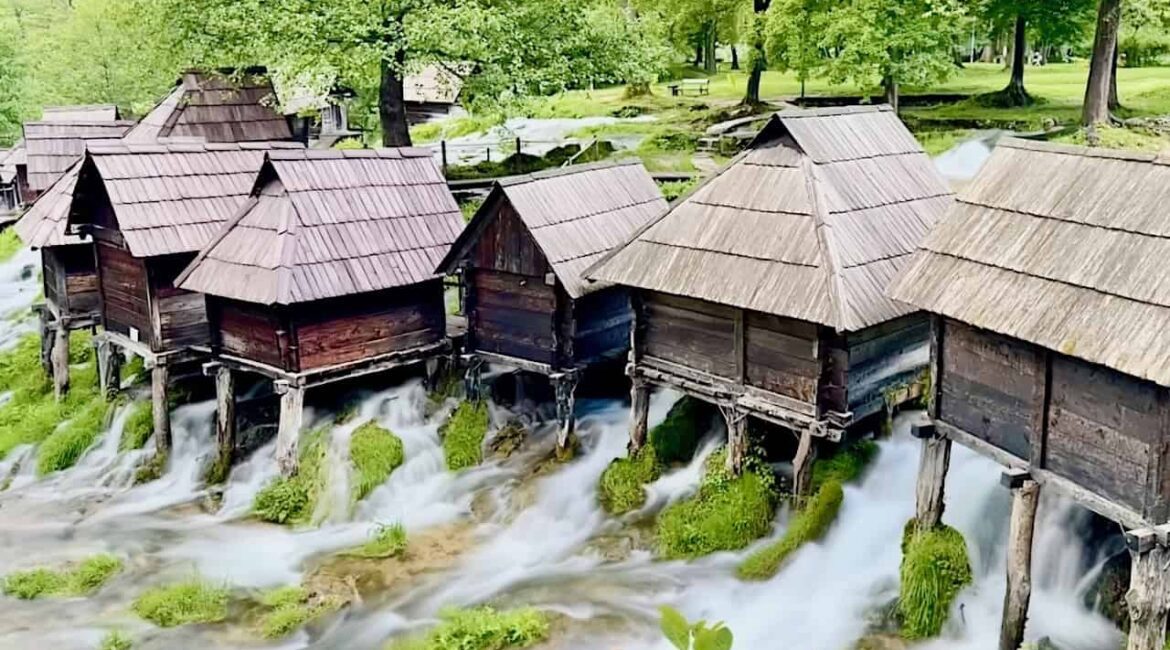
We crossed the Bridge of Love and wandered through Mlinčići, a photogenic collection of 16th-century watermills perched above cascading falls.
Bridge of Love
This cluster of historic mills were once used to grind wheat and have been preserved as cultural monuments. A network of elevated, wooden walkways allows you to stroll around the mills. It’s such a lovely, serene spot surrounded by lush forests.
Mlinčići watermills
Mlinčići watermills
Jajce
We then proceeded to Jajce (map), a historic city that was the capital of the medieval Kingdom of Bosnia. The town changed hands between Bosnian, Hungarian and Ottoman rulers, reflecting centuries of conflict and cultural exchange.
Jajce
In the 20th century, it played another key role when it hosted a meeting that laid the foundations for Yugoslavia. Here are some of the places of interest we visited in Jajce:
Jajce Citadel
Our first stop was the Citadel, perched on a hilltop overlooking the old town. This medieval citadel offers sweeping views and insight into Jajce’s past as a fortified seat of power. The old city core, defensive walls, and bastions date back to the 14th century.
The medieval citadel
Old Town
From the fortress, we then strolled down to the old town through cobbled alleys, passing the Church of St. Mary, where Bosnia’s last king was crowned in the 15th century, and the medieval Bear Tower. We also passed historic catacombs and archaeological remains, including a rare Roman-era Mithras temple.
St. Mary’s Church and bell-tower
Bear Tower
Pliva Waterfall
Our walk ended at arguably the highlight of the day: the Pliva Waterfalls. This spectacular 18-meter cascade drops into the Vrbas River right in the centre of town. It was a picture-perfect conclusion to my central Bosnia day trip!
Jajce waterfall
If you’re visiting Sarajevo or touring Bosnia, don’t miss Travnik and Jajce. It was an absolutely delightful day trip full of history, nature and culture.
Read more about Bosnia and Herzegovina:
Note: my stay in Bosnia and Herzegovina was made possible by Meet Bosnia Tours. As always, all opinions above are mine.


0 Comments