
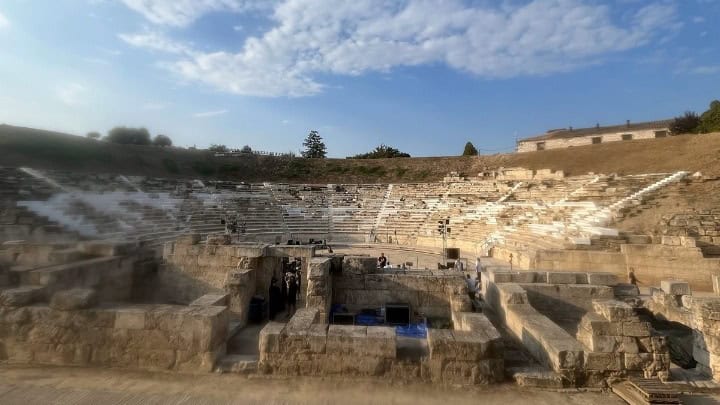
Cultural Ministry Restores Larissa Ancient Theatre

The Greek Ministry of Culture, through the Ephorate of Antiquities of Larissa, advanced the restoration of the stage building of the Ancient Theatre of Larissa.
According to the Ministry of Culture, the interventions aimed to improve the structural stability, appearance, and overall functionality of the monument. Authorities also strengthened the theatre’s capacity to host performances of ancient drama, enhancing its cultural use.
The restoration of the proskenion formed part of the broader project, which already progressed with a budget of approximately €7 million. Funding came from the Regional Operational Programme “Thessaly” – NSRF 2014–2020 and 2021–2027.
Culture Minister Lina Mendoni stated that the Ancient Theatre of Larissa, Theatre A, with a capacity of 11,000 spectators, was constructed during the Hellenistic period on the site of the city’s fortified Acropolis and remained in operation until the early 4th century AD. Three years ago, following restoration works, the cavea hosted theatrical performances after 2,000 years of silence, reconnecting the monument with the cultural life of the city and the wider region.
In the current phase of archaeological works, authorities placed emphasis on the full restoration of the proskenion, installation of new marble blocks, reinforcement of beams and columns, and conservation of ancient fragments using modern techniques. The ministry aimed to ensure structural integrity, highlight architectural value, and safeguard the monument.
Mendoni noted that the reuse of the ancient theatre represented a key step in preserving the city’s monumental heritage, integrating it into contemporary cultural life and restoring its historical continuity. Restoration of the former Military Bakeries, intended to house support functions and host activities and exhibitions, complemented the theatre’s development as part of a modern and sustainable cultural complex open to the public.
Authorities considered fire protection measures necessary due to the presence of visitors not only for monument viewing but also for participation in cultural events. Similar fire safety measures also applied to the city’s second ancient theatre.
The Ancient Theatre A, dating to the first half of the 3rd century BC, stands as one of the largest Hellenistic monuments in Greece. Located on the “Frourio” hill, it remained functional for approximately six centuries. During the Roman period, the theatre was converted into an arena and constructed entirely from marble. The monument features a high-quality stage building with Doric semi-columns and elaborate marble elements.
The main theatre is divided by ten stairways into eleven kerkides and originally included 24 seating rows. When converted into an arena in the 2nd century AD, authorities removed the first three rows and constructed a podium around the orchestra.
The stage building has a rectangular plan with a proskenion, four rooms, and three corridors. External walls feature a marble façade with Doric semi-columns, while the proskenion includes a stoa formed entirely of marble elements. In the early 1st century AD, five statues of the imperial family were installed with dedicatory inscriptions. In its final period of use, the theatre functioned entirely as an arena.
The preservation condition of the stage building remains generally good, largely due to conservation works carried out in 2002–2003. Damage sustained over centuries was categorised as structural deterioration and surface wear of the building material.
According to the Ministry of Culture, the fire protection project for Theatre A includes installation of a water supply network with fire hose cabinets for immediate use in case of fire, safety lighting to ensure sufficient illumination along escape routes, and portable fire extinguishers placed at key points such as emergency exits and areas with electrical equipment.
The plan also includes installation of a manual fire alarm system for early warning, as well as a central fire detection panel. Authorities aimed to ensure early detection and response to fire incidents, safe evacuation of the site, and protection of both visitors and the monument.
Corresponding fire protection measures also applied to the second ancient theatre of Larissa, dating to the 1st century BC, which consists of the stage building preserved at foundation level, the parodoi, the orchestra, and two seating rows. Today, the site operates as an active venue hosting performances.
Stay updated with the latest news from Greece and around the world on
greekcitytimes.com.
Contact our
newsroom
to share your updates, stories, photos, or videos.
Kosta Papadopoulos
Kosta is a journalist covering geopolitics, defence and Hellenic diaspora news.


0 Comments