
Ancient Shipwrecks Shed Light on the 2,300-Year-Old Greek City of Ptolemais in Libya

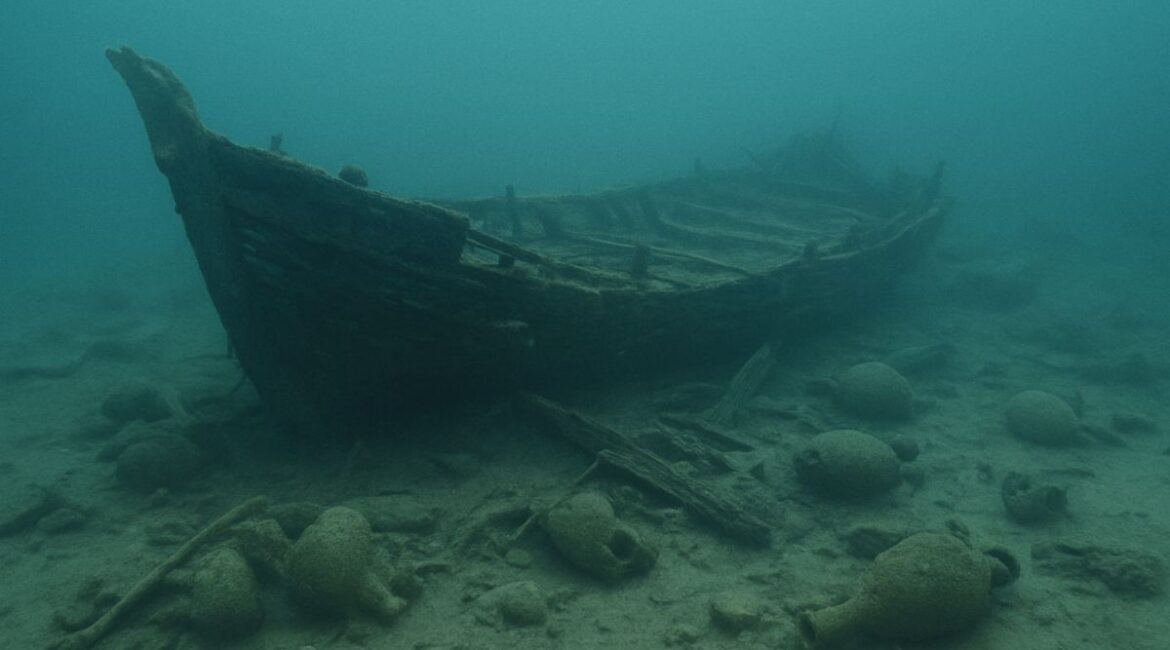
An interpretation of an ancient shipwreck. Credit: Greek Reporter Archive
A cluster of ancient shipwrecks off the northeastern coast of Libya is shedding new light on the harbor of Ptolemais (Greek: Πτολεμαΐς), a 2,300-year-old Greek city that once served as a major regional center.
The wrecks, which span roughly 328 feet of seabed near the ancient port, reveal centuries of maritime activity and suggest that the harbor was both bustling and challenging to navigate.
The site has been studied by a team from the University of Warsaw, which returned in 2023 after a twelve-year hiatus caused by civil conflict. Since then, researchers have conducted extensive work on land and underwater, uncovering evidence of trade, infrastructure, and daily life.
Shipwrecks off Ancient Greek city of Ptolemais in Libya show evidence of repeated ship losses
Experts indicate that the wrecks did not result from a single incident but represent multiple ship losses across various time periods. Archaeologists believe many vessels never reached the harbor due to hazardous coastal conditions. Strong currents, limited visibility, and submerged obstacles likely made navigation treacherous.
Initial clues emerged about two and a half miles offshore, where scattered amphorae formed a trail on the seabed. These jars, used to transport goods such as wine, guided researchers to cargo fragments, ship components, and ultimately entire wreck sites. The pattern points to repeated struggles by ships attempting the final approach to Ptolemais.
Shipwreck artifacts highlight trade and craftsmanship at Ancient Greek city of Ptolemais
Among the recovered objects is a bronze aequipondium, a weighted component of a Roman balance scale. Filled with lead and shaped like a woman’s head, it demonstrates both practical function and artistic craftsmanship.
Researchers also uncovered several amphorae, including one that still contained crystallized wine. The substance is currently being analyzed to shed light on ancient storage methods and trade practices. These discoveries reinforce the view that Ptolemais was a thriving trading hub in the Mediterranean.
Submerged port reveals large harbor complex
Between 2024 and 2025, underwater archaeologists uncovered extensions of the port, including remnants of columns, sections of roads, ship anchors, and tools once used to measure sea depth.
These findings indicate a well-developed harbor system. Researchers note that portions of the port were later submerged as rising sea levels and seismic activity reshaped the coastline over time.
Land discoveries show organized urban life of Ptolemais in Libya
Ruins of ancient structures in Ptolemais, Libya. Credit: David Stanley / CC BY 2.0
On land, a team led by Szymon Lenarczyk uncovered a road designed for wheeled transport leading toward the hilltop city. A Greek inscription from the 3rd century AD was also identified near the city gates.
Inside Ptolemais, archaeologists identified remains of a residential district. One structure included an entrance area linked to the home of a high-ranking official, suggesting a structured social order. Nearby, researchers found a mask shaped like a human face and several stone containers placed outside the building. Their purpose remains unclear.
Conservation and future work continue
Conservation teams are restoring wall mosaics and painted surfaces uncovered at the site. They are also working on a rare double-disc sundial, first discovered in 2010, which offers a valuable example of ancient timekeeping.
Researchers emphasize that the excavation is still in its early stages. With work now fully resumed, further discoveries are expected to provide deeper insight into the history of Ptolemais and its role in Mediterranean trade.


0 Comments