
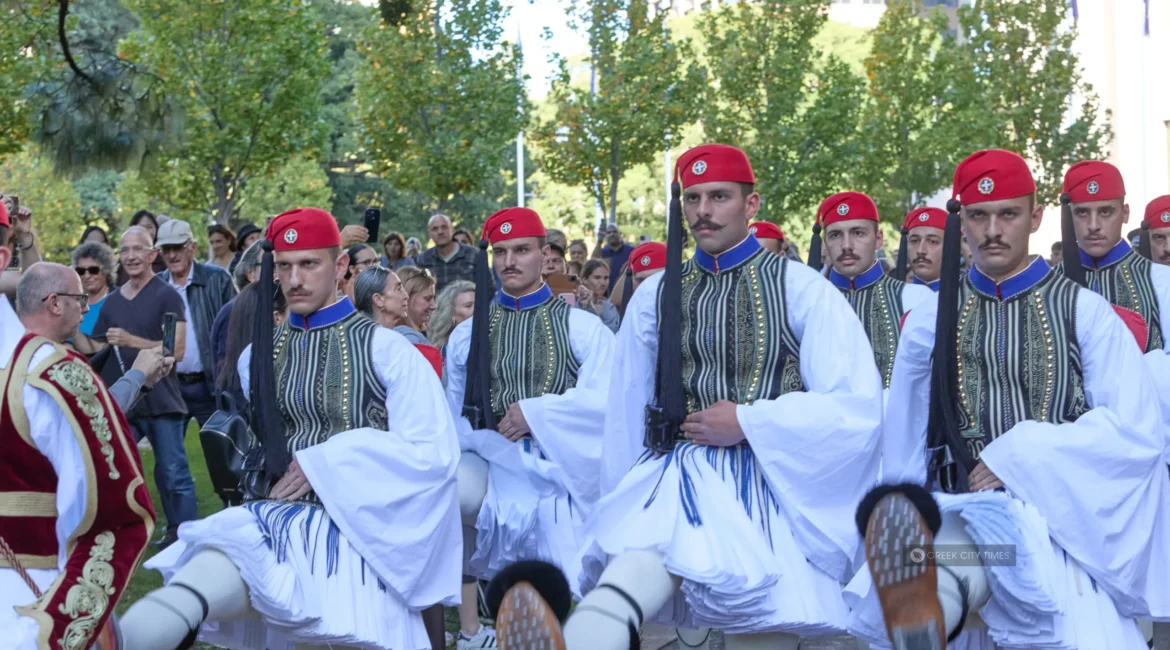
400 Folds of History, Pride, and Heroism

Can a men’s skirt embody bravery, resistance, and national pride?
In Greece, the answer is an emphatic yes.
The fustanella (Greek: φουστανέλα) is a traditional male garment resembling a pleated skirt, crafted from dozens—sometimes hundreds—of narrow folds. Made of white fabric and flaring to the knee, it is one of the most instantly recognizable symbols of Greek identity. Once worn by mountain warriors and revolutionaries, the fustanella today captivates millions of visitors on the streets of Athens, most famously through the ceremonial guards known as the Evzones.
This article traces the long and remarkable journey of the fustanella—from its ancient inspirations and its role in the Greek War of Independence to its modern ceremonial significance—revealing the powerful cultural meaning hidden in every fold.
What Is the Fustanella?
The fustanella is a traditional men’s garment that closely resembles a pleated kilt. Typically made from white cotton, it is defined by its dense, narrow folds. Although often compared visually to the Scottish kilt, the fustanella developed independently within the cultural landscape of southern Europe.
Historically, it was worn across Greece, Albania, and other Balkan regions as both folk dress and military attire. In Greece, it became especially associated with mountainous areas, where mobility, durability, and symbolism mattered. Over time, the white flared skirt evolved into an emblem of Greek national identity—so much so that today it is impossible to imagine the Evzones without it.
Despite its skirt-like appearance, the fustanella conveyed masculinity, courage, and social status. It was heavy, voluminous, and difficult to arrange correctly—wearing it required strength and discipline. For centuries, it was favored not by farmers, but by highland warriors, armed bands, and fighters. Before the emergence of the modern Greek state, it was the attire of klefts (mountain bandits and resistance fighters) and armatoloi (local militias). Only later did it become a symbol embraced by the entire nation.
The origins of the fustanella are as layered as the garment itself. Several theories trace its beginnings to antiquity. Some scholars link it to the ancient Greek chiton, a short tunic that, when belted, formed folds similar to those of the fustanella. Others point to Roman military dress, where soldiers and emperors were often depicted wearing armor with pleated skirt-like tunics.
Archaeological evidence supports its long history. In present-day Albania, figurines dating back to the 4th century CE depict men wearing garments strikingly similar to the fustanella, suggesting continuity across centuries.
The word fustanella likely derives from the Italian fustagno (fustian), a sturdy cotton fabric. The diminutive suffix -ella suggests “a small skirt made of fustian,” reflecting the garment’s practical origins among mountain communities that required durable clothing for harsh conditions.
From Outlaws to National Heroes
For centuries, the fustanella symbolized independence and the fierce spirit of Balkan highland culture. During the 18th and early 19th centuries, it was commonly worn by klefts—figures who were both feared bandits and celebrated resistance fighters against Ottoman rule—as well as by armatoloi tasked with maintaining order in remote regions.
When the Greek War of Independence broke out in 1821, many of these fighters formed the backbone of the revolutionary forces. Their white, pleated skirts transformed from the attire of outlaws into the uniform of national heroes. Legendary figures such as Theodoros Kolokotronis and Markos Botsaris became inseparable from the image of the fustanella-clad warrior.
European Philhellenes romanticized this image. The British poet Lord Byron, one of the most famous supporters of the Greek cause, was enthralled by the Albanian-Greek costume, calling it “the most magnificent in the world.” He wore it himself—complete with a long white skirt, gold-embroidered vest, scarlet coat, and ornate weapons—helping popularize the fustanella across Europe as a symbol of heroic resistance.
By the 1820s, the garment appeared widely in paintings, engravings, and literature celebrating the Greek struggle for freedom, cementing its place as an international symbol of bravery and sacrifice.
The Fustanella as Greece’s National Costume
After independence, the newly formed Greek state embraced the fustanella as a marker of national identity. In 1833, King Otto, the first monarch of modern Greece, officially incorporated it into the uniform of the national army. Many soldiers were former revolutionaries, making the transition natural.
By 1835, the fustanella had become official court dress. King Otto posed in portraits wearing the uniform of an Evzone against the backdrop of ancient ruins, symbolizing continuity between ancient and modern Greece. Queen Amalia reinforced this cultural revival by designing a national costume for women.
Although Western clothing gradually replaced traditional dress in daily life, the fustanella endured in ceremonial and military contexts. It remained prominent in elite units and rural festivals well into the 20th century. Today, it survives most visibly through the Evzones.
Symbolism and Cultural Meaning
The fustanella is far more than clothing—it is a visual narrative of Greek history.
- 400 Pleats: Traditionally said to represent the 400 years of Ottoman rule. While the exact number varies, the symbolism endures.
- White Color: Symbolizes purity, virtue, and freedom.
- Red Fez (Farion): Represents the blood shed for independence.
- Black Tassel: Signifies national mourning for fallen heroes.
- Blue-and-White Tassels (Krossia): Reflect the colors of the Greek flag—sea, sky, and unity.
- Gold-Embroidered Vest (Fermeli): Often adorned with religious symbols, highlighting the role of Orthodoxy in Greek identity.
Together, these elements form a wearable monument to Greece’s past.
The Fustanella Today: Evzones as Guardians of Tradition
Today, the most famous wearers of the fustanella are the Evzones, the elite ceremonial guards of the Hellenic Presidential Guard. They stand watch at the Tomb of the Unknown Soldier outside the Greek Parliament in Syntagma Square, representing the nation at major events and honoring those who fell in battle.
Their discipline, precision, and striking attire make them one of Greece’s most admired symbols.
The Changing of the Guard
The ceremony takes place every hour, day and night, drawing visitors year-round. The most elaborate display occurs during the Grand Change on Sundays at 11:00 a.m., when the full unit marches with a military band.
The slow, deliberate movements—marked by high leg lifts—are both ceremonial and practical, helping restore circulation after long periods of stillness.
To become an Evzone, soldiers must meet strict physical requirements, including exceptional height (around 1.87 m / 6′2″), endurance, and discipline. Dressing in full ceremonial uniform can take up to 30 minutes.
Fun Facts About the Fustanella and the Evzones
- A Record Number of Folds: A ceremonial fustanella uses about 30 meters (100 ft) of fabric and around 400 pleats.
- Colors of Blood and Tears: The red fez and black tassel narrate Greece’s sacrifices.
- Heavy Boots with a Secret: Evzones wear tsarouchia, leather shoes weighing about 1.5 kg each, fitted with metal nails. The black pompons once concealed blades.
- Master Craftsmanship: Each uniform consists of around a dozen components. The embroidered vest alone can take up to six months to complete.
- Not Only Greek: The fustanella was historically worn across the Balkans, especially by Albanian highlanders, reflecting shared cultural traditions.
A Living Monument of Greek Culture
In modern Athens, seeing soldiers in white pleated skirts may seem surprising. Yet once the story behind the fustanella is understood, its presence feels deeply fitting.
Watching the Evzones march in Syntagma Square is not merely observing a military ritual—it is witnessing living history. Every pleat, every step, every detail carries centuries of struggle, pride, and resilience.
The fustanella is more than a garment.
It is the Greek spirit, proudly unfolding with every movement.
Greek Presidential Guard Anniversary: Evzones Mark 157 Years
Tags:Athens tourist attractions, Balkan traditional clothing, changing of the guard Athens, Evzones, Fustanella, fustanella history, Greek cultural heritage, Greek folk costume, Greek history symbols, greek identity, Greek military traditions, Greek national costume, Greek Presidential Guard, Greek soldiers uniform, Greek traditional dress, Greek War of Independence, klefts and armatoloi, Lord Byron Greece, Ottoman occupation Greece, Syntagma Square Evzones


0 Comments