
1,500-Year-Old Mosaic with Playful Greek Inscriptions Unearthed in Ancient Greek City of Syedra Greek City Times

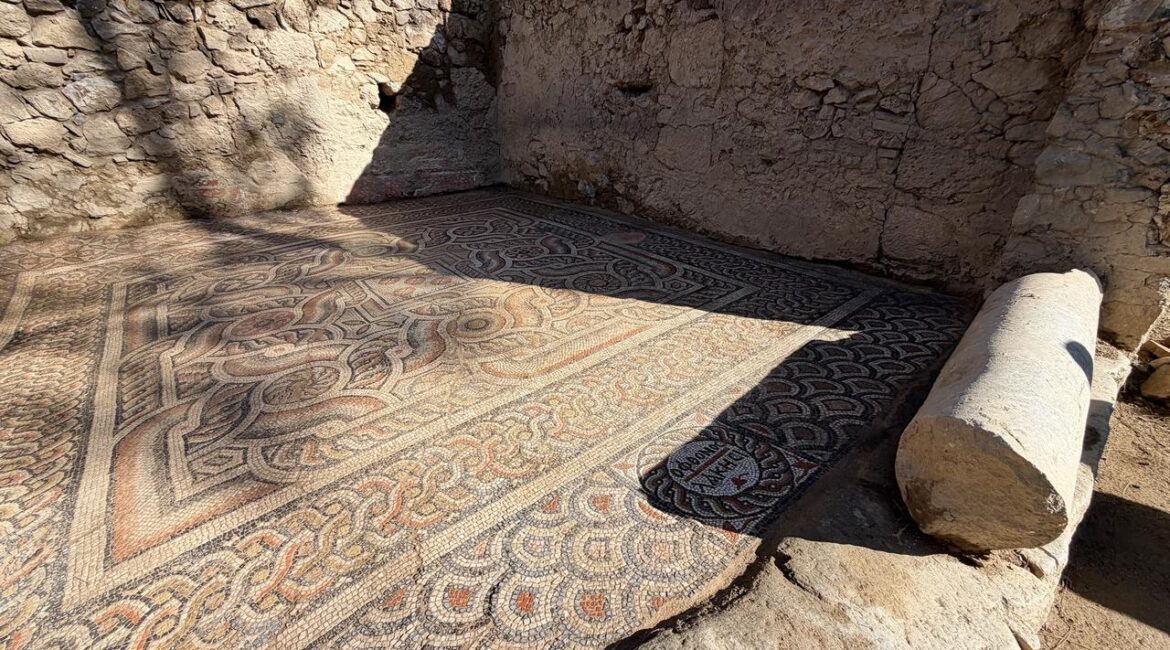
ANTALYA, Turkey (March 16, 2026) — Archaeologists have discovered a remarkably well-preserved mosaic floor dating back approximately 1,500 years in the ancient Greek-founded city of Syedra, near Alanya on Türkiye’s Mediterranean coast.
Originally settled by Greeks around the 7th century BCE in the region of Cilicia, Syedra was a Hellenistic foundation that later flourished as a Roman center from the 1st century BCE through the 7th century CE. The site’s Greek heritage is vividly reflected in this latest find: a 4.5 by 4.5 meter mosaic from the 5th or 6th century AD, featuring intricate geometric and floral motifs alongside two Greek inscriptions with welcoming yet cheeky messages.
One inscription reads “Use it with joy” (a hospitable invitation to guests), while the other translates to “May the envious burst with jealousy” or “Let the envious burst!” — a playful defense against envy and the evil eye, common in late antique domestic settings to express pride, hospitality, and protection from misfortune.
The mosaic was uncovered in the entrance area of a large residential complex during excavations led by the Turkish Ministry of Culture and Tourism and the General Directorate of Cultural Heritage and Museums, under the “Heritage for the Future” project.
Associate Professor Dr. Ertuğ Ergürer, excavation director from Alanya Alaaddin Keykubat University, stated: “We are excavating what seems to be an important residential building. The structure was continuously modified and remained in use from the 2nd century AD until around the 7th century AD, reflecting several phases of habitation and architectural change during the early Byzantine period.”
The floor has survived in exceptional condition, with conservation and restoration work promptly completed to ensure its preservation.
Syedra, though lesser-known today, holds historical significance. Ancient writers like Lucan and Florus reference it as the site of Roman general Pompey’s final war council in 48 BC before his flight to Egypt. At its peak in the 2nd–3rd centuries AD, the city boasted advanced infrastructure, including city walls, roads, baths, temples, cisterns, a council building, a colonnaded street, and an sophisticated rainwater collection system via rock-cut cisterns to address local water scarcity.
Domestic artifacts like this mosaic provide rare, personal insights into ancient daily life — revealing humor, social attitudes, and how ordinary people decorated their homes and greeted visitors — complementing the grander public monuments that highlight politics and religion.
Image credits: General Directorate of Cultural Heritage and Museums of Turkey (via official excavation releases and reports).
Sources: General Directorate of Cultural Heritage and Museums of Turkey, Alanya
Tags:
Alanya, ancient Greek city, archaeology Turkey, Byzantine period, cultural heritage Greece, evil eye protection, Greek, Greek inscriptions, Greek news, Hellenistic period, hospitality inscriptions, late antiquity, Mediterranean coast, mosaic floor, Pompey Syedra, residential complex, Syedra, Turkish excavations


0 Comments