
The most beautiful cities of Ancient Greece

Although most tourists associate Ancient Greece with Athens and its numerous sights, such as the Parthenon, the Herodion of Atticus theatre, or the Temple of Olympian Zeus, there are hundreds of additional places around the country that are home to some of the most important archaeological findings in Greece.
In fact, in almost every Greek city or on every Greek island, you will find ancient monuments, sculptures, or remains of ancient buildings, which serve as evidence of the country’s grand historical past.
Many of these monuments are UNESCO World Heritage Sites not just because of their majestic architecture or age, but also because of their contributions to modern civilization, society, art, and science.
Apart from the capital of Greece, here are some of the most important cities of antiquity that testify to the country’s rich history, and are considered today brilliant tourist attractions.
Knossos, Crete (Κνωσός, Κρήτη)
Knossos is the most important centre of the Minoan Civilization, the home of King Minos, but also the magical place where the myths and legends of the Labyrinth, Theseus, and the Minotaur originated.
Although the Minoan Civilization was destroyed in 1650 BC by a series of large tsunamis in the Aegean Sea, caused by the eruption of the Santorini volcano, which split the island in two, many of the masterpieces of Minoan art can still be admired to this day by visitors at the Archaeological Museum of Heraklion in Crete.
Modern representation of what the Minoan Palace looked like in 1640 BC.
Mycenae, Peloponnese (Μυκήνες, Πελοπόννησος)
The city of Mycenae is home to one of the world’s oldest civilizations, and presumably the oldest in Europe. According to archeologists, the first human activity in the area dates back to the 7th millennium BC, during the Neolithic Era.
Mycenae has also gone down in history as the kingdom of Agamemnon and the House of Atreus, while its participation in the Trojan War played a crucial role in the development of Greek history.
Delos, Cyclades (Δήλος, Κυκλάδες)
According to research data by the Greek Ministry of Culture, “it is estimated that around 90 BC, the small island of Delos was just a dot on the map of the Mediterranean Sea, and home to only 30,000 people.” Excavations, which began in 1872 and are still ongoing, have uncovered a large sanctuary on the island and many other Hellenistic-era monuments, proving that Delos was a place of great significance in the ancient world.
Ancient Messene, Peloponnese (Αρχαία Μεσσήνη, Πελοπόννησος)
The archeological site of Messene is one of the largest and most remarkable sites in Greece, and is home to many athletic events, famous theatre plays, and ceremonies of the ancient world.
Messene is also considered the place where Greek was born, as the earliest written evidence of the language is a Linear B clay tablet found in Messinia and dating to 1450 – 1350 BC, making Greek the world’s oldest recorded living language.
Photo by Constantakopoulos Foundation
Philippi, Kavala (Φίλιπποι, Καβάλα)
Philippi was an ancient city in Kavala, Eastern Macedonia, with strong military power, and it flourished during the Hellenistic period. In 42 BC, Octavius Augustus turned Philippi into a Roman colony, while there, in 49-50 AD, Apostle Paul founded the first Christian church on European soil.
Photo by MyGreekHoliday.gr
Dion, Pieria (Δίον, Πιερία)
Although Dion is a small village, it hosts one of the most charming archaeological sites of Greece, with lots of ancient ruins from temples, full body sculptures and columns, that are spread across its area.
According to the Greek Ministry of Culture, the existence of Dion was discussed for the first time by historian Thucydides, in 424 BC.
The excavations in Dion began in 1928 by the Aristotelion University of Thessaloniki but were paused several times due to the World Wars and finally ended in the 1970s.
Lindos, Rhodes (Λίνδος, Ρόδος)
Lindos has been called “the Jewel of Rhodes” and is also considered one of the most popular archaeological destinations in Greece. The Temple of Lindia Athena is the most famous attraction on the island, built at the top of an acropolis at 116 meters. In front of the hill, visitors can enjoy the wonderful view of the Aegean Sea and the picturesque settlement of Lindos, with its small white houses.
Photo by Greek Travel Pages
Akrotiri, Santorini (Ακρωτήρι, Σαντορίνη)
Santorini may be the home of the world’s most famous and beautiful sunset, but its historic importance is significant as well.
The small village of Akrotiri on the south peninsula of the island is one of the most important centres of the Greek prehistoric times, with remains of old civilizations dating back to the Late Neolithic Age.
According to historians, the people of Akrotiri were killed during the volcanic eruption of the island, and even those who managed to escape were killed by the large tsunamis that resulted, which reached even Crete and destroyed the Minoan Civilization.
Instagram: @christine_edounis
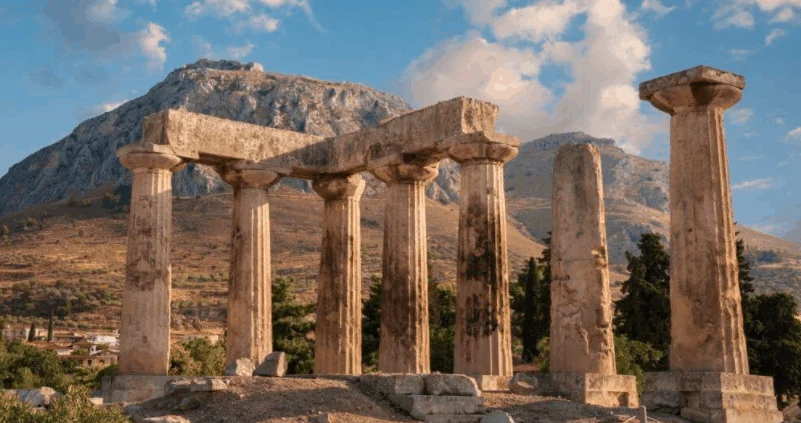
Acrokorinthos, Korinthos (Ακροκόρινθος, Κόρινθος)
The ancient settlement and castle of the historic city of Korinthos are located on the northern side of the hill of Acrokorinthos, and can be admired by visitors who pass by. Excavations have brought to light the Roman Agora, temples, galleries, fountains, baths, and more ancient monuments. The archaic temple of Apollo and the Pyrenees Fountain are among the most important sights.
Pella, Macedonia (Πέλλα, Μακεδονία)
The ancient city of Pella in Central Macedonia is the historical capital of the ancient kingdom of Macedon and the birthplace of Alexander the Great.
It covers about 4,000 acres, but even to this day, it has not been excavated in its entirety, as new ancient finds are discovered every year. The Palace, the houses with mosaic floors, the sanctuaries, and the tombs found in the area give us a taste of Greece’s past greatness.
Related news Greece Affirms Global Influence Through UNESCO Achievements
Tags:
Agamemnon, Alexander the Great, ancient Greece, Ancient Meseene, Apostle Paul, Aristotelion University of Thessaloniki, Crete, Cyclades, Dion, Eastern Macedonia, House of Atreides, Kavala, Knossos, Korinthos, Late Neolithic Age, Lindos Rhodes, Messinia, Minoan civilization, Mycenae, Octavius Augustus, Pella, Peloponnese, Philippi, Pieria, Santorini, Temple of Olympian Zeus, the Herodion of Atticus Theatre, the Parthenon, Thucydides, Troy, UNESCO, UNESCO World Heritage Sites


0 Comments