
Historic Return of Looted Greek Jewish Treasures from Poland

Greece secured the repatriation of 91 Greek Jewish artefacts from Poland, marking the first return of cultural goods by Poland to their country of origin.
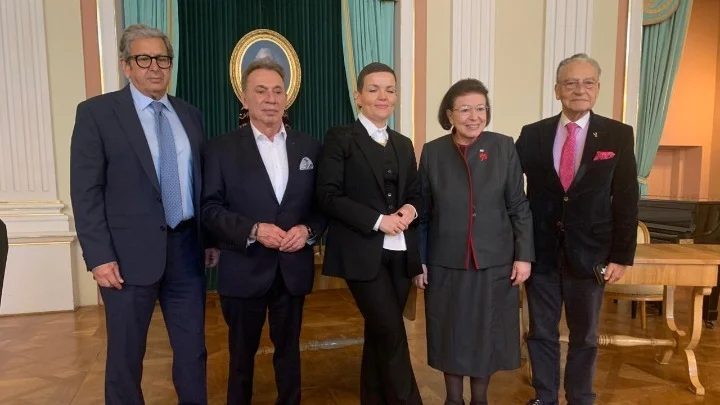
Culture Minister Lina Mendoni travelled to Warsaw to formally receive the historic collection following an agreement between the Greek and Polish governments through their respective culture ministries.
The 91 valuable Greek Jewish religious artefacts had been stolen from synagogues and Greek Jewish families during the Second World War and the Nazi occupation by the German organisation Einsatzstab Reichsleiter Rosenberg, which systematically looted cultural property, artworks, libraries and archives across occupied Europe.
“A historic milestone”
In her address, Mendoni stated that the artefacts, removed from synagogues across Greece during the war, were finally returning home after decades.
She stressed that the items carried not only historical and artistic value but also formed part of Greece’s living memory and that of Greek Jews. She noted that they were connected to families who never returned from the camps as victims of the Holocaust.
Mendoni described the repatriation as the result of a long and demanding process. She thanked Polish Culture Minister Marta Cienkowska and her predecessor Hanna Wróblewska, as well as Polish authorities, for overcoming legal and administrative obstacles.
“Without the strong political will of both sides, today’s repatriation would not have been achieved,” she said.
She added that Greece consistently pursued the return of cultural treasures removed from its territory, citing as the most emblematic case the Parthenon Marbles. At the same time, she underlined that Greece returned cultural goods identified within its borders as products of illegal trafficking and worked through bilateral and multilateral agreements and within UNESCO to combat illicit trade in cultural property.
Poland establishes new path
Cienkowska described the handover as a historic moment and confirmed that Poland treated the issue as a priority from early 2024. She explained that Poland had applied a special legal procedure to allow the return of objects unlawfully removed from foreign states and held in Poland.
She said the close cooperation between the two ministries and the systematic work of experts enabled the return in less than two years.
Decades-long effort
After the end of the Second World War, Polish authorities located part of the German looted property stored in castles in Lower Silesia. On 14 September 1951, Poland’s Ministry of Culture transferred the Greek Jewish objects to the Jewish Historical Institute “Emanuel Ringelblum” in Warsaw, where experts identified them as Greek.
Greece’s Culture Ministry, in cooperation with the Jewish Museum of Greece, had pursued their return since 2001. However, the lack of a specific institutional framework in Poland delayed progress. The Greek ministry submitted a formal request in December 2024, prioritising the long-pending case within its broader repatriation strategy.
The collection included 46 liturgical textiles, 17 pairs of rimonim crowning Torah scrolls, nine individual rimonim or fragments and one pair of hanging ornaments. Experts from the Jewish Museum of Greece completed updated documentation and identification studies in 2022.
The World Jewish Restitution Organization encouraged the return. Authorities will now deliver the collection to the Jewish Museum of Greece, concluding a decades-long effort to restore a significant part of the country’s Jewish heritage.


0 Comments