
Highlighting KDIH’s Early 2026 Battlefield Tour Schedule

Knee Deep Into History leads WW1 and WW2 small-group multi-day battlefield tours in Western Europe designed to bring battles to life. The company grew out of founder Randy Gaulke’s eight months of living in France as a freelance tour guide during the Centennial of WW1 in 2017-18. During those months, Randy became intimately familiar with the American Expeditionary Forces battlefields of WW1, hiking and exploring remote areas, including the Argonne Forest, to search for the physical remains of the war. In September 2018 he partnered with retired German Bundeswehr Officer, Markus Klauer, to offer a six-day tour where each daily agenda included one or more walks of moderate length and duration, allowing participants to experience a battlefield in the same way as the soldiers and officers who fought it. Fast forward to 2026, Knee Deep Into History is now in its sixth season, and our tours continue to build upon those tenets. This article will focus on our early 2026 battlefield tour offerings, and we hope that it will encourage you to join us for an unforgettable battlefield tour experience.
Tour hikers emerging from the Lost Battalion Pocket, near Binarville, France, Sept. 2018
Third Reich Underground Tour, 18-23 May (WW2)
Our first 2026 battlefield tour is designed and led by Graham Gaulke. This fascinating above- and below-ground tour in Central Germany looks at Nazi efforts to conceal its armaments industry from aerial bombardment by dispersing it and moving it underground. It also explores the role of concentration camp and forced labor in this effort. Graham’s first underground exploration of the topic began 12 years ago in 2014, and he has since explored the remains of hundreds of sites associated with Nazi Germany’s armaments industry.
A partial list of sites to be visited includes: Mittelbau-Dora concentration camp, where V-2 rockets and V-1 flying bombs were assembled; the Walpersberg (mountain), under which Me-262 jet fighters were assembled; an underground jet fuel refinery, where Jewish-American POWs were forced to excavate over a dozen tunnels; and the Merkers salt mine, where Patton’s Army discovered the Reichsbank’s gold reserves.
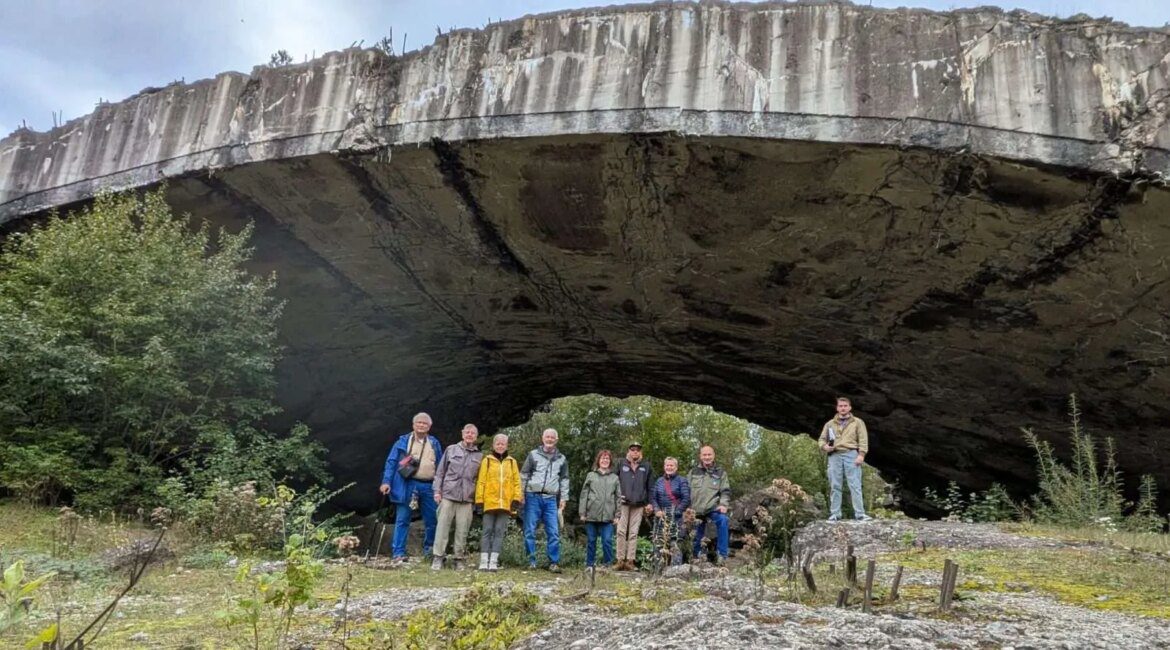
Natural cave used to produce WW2 German aircraft parts using forced labor
Hiking the Walpersberg, where Me-262 aircraft were assembled inside the mountain before being launched atop the mountain, May 2024
WW2 American Experience 28th Inf. Div. Tour, 27 May – 4 June (WW2)
Our second 2026 battlefield tour highlights Pennsylvania’s 28th (National Guard) Infantry Division, better known as the “Bloody Bucket.” The division landed in France shortly after D-Day and participated in the Normandy break-out. After chasing the enemy across France in the Fall of 1944, the division would face several severe tests in late 1944 and early 1945, including the Huertgen Forest, Hitler’s Ardennes Offensive and the Colmar Pocket. Participants will have the opportunity to explore each of these battlefields in depth, with several walks planned throughout the trip.
The tour is timed to end just prior to the annual D-Day commemorations in Normandy, so participants can elect to remain in France on their own for those events.
American cross in the Huertgen Forest, where the 28th Inf. Div. suffered terrible casualties
Soldiers of the 28th mingling with the citizens of Bastogne, Sept. 1944. Just a few months later, the Germans would return and the division would pay a terrible price.
Somme and Verdun 110th Anniv. Tour, 28 June – 2 July (WW1)
Our third 2026 battlefield tour commemorates the battles of attrition: 1916 marked the midpoint of WW1 and is best known for the battles of attrition on the Western Front: Verdun and the Somme. The opening days of this tour will explore the strategies, human cost and failings of the Verdun battle that began on 21 February and continued into December 1916.
The second half of the tour will focus on the Franco-British Somme Offensive, designed to relieve the pressure on the French from Germany’s Verdun Offensive. This battle began on 1 July, a day forever known as the bloodiest day for the British Army, with a striking 60,000 casualties. The tour is timed to allow participation in a select number of 110th anniversary commemorations on 1 July, including the blowing of the Lochnagar mine crater at 7:28am.
Period photo showing the remains of Fort Douaumont on the Verdun battlefield, part of our walking tour of Verdun.
The Thiepval Memorial to the Missing on the Somme during the commemoration. Photo by Wim Degrande.
A Typical Day Getting Knee Deep Into History
Our typical day begins with a wonderful breakfast spread at the hotel. Vans depart at 9:00am, and we are “in the field” generally until around 5:00pm. Lunch typically consists of fresh sandwiches prepared that morning by local bakeries and eaten in the field. The vans are also equipped with snacks and beverages to give clients an energy boost when needed.
European bread is a great part of breakfast before the tour departs.
The same is true for French cheese!
We try to work in one or two walks of moderate length and duration each day, because there is no better way to experience a battlefield than walking it! Most clients participate in the walks. However, there is always the option to remain with the vehicles. We have had a handful of guests who are 80+ years old, and they have kept up with the group. (The best way to prepare for a KDIH tour is to get out and move beforehand, walking one to two miles per day at a measured pace on country trails. Walking poles help too.)
Stopping to photograph battlefield remains on one of our walks.
Sandwich lunch in the field
Clients have personal time from around 5:00pm to 7:00pm, before joining the guides again for a beautifully prepared multi-course European dinner at our hotel/restaurant.
The small-group tour structure offers several benefits to clients: Questions can be asked and answered easily throughout the day—in the vans or over dinner. It is much easier to get to know the other clients on a 6 to 12-person tour versus a 20+ person tour. Also, the tour itinerary can be tweaked to visit sites where, perhaps, a client’s relative fought and fell.
Multi-course European dinners provide a chance to reflect on the day. The location is one of Nuremberg’s oldest sausage kitchens.
Other Things to Know
Our tours begin and end at a major European airport. Clients are responsible for making their travel arrangements before and after the tour; but we can certainly provide suggestions.
Once at the starting point, our tours are all-inclusive except for dinner drinks and personal souvenirs.
Because we emphasize bridging cultures, our multi-day tours typically have one or two cultural events built in. For example, the 28th Infantry Division tour will spend a half day at Mont St. Michel, and it will also include a Calvados tasting. Our guides are either European or Americans who have lived in Europe for several years. Thus, we can help you with any questions or concerns that might arise. We helped one Michigan resident get a sleeping pill prescription faxed from his doctor to a French pharmacy, and the pharmacist filled it.
Yes, we also design bespoke tours for individuals and bespoke tours for associations.
If all of the details seem overwhelming at first, have a look at our webpage, view our philosophy, testimonials and Q&A. Finally, reach out to Randy at kneedeepintohistory@gmail.com with any questions. We invite you to get knee deep into history with us in 2026!
After decades of personal battlefield tours, Randy Gaulke quit his job as a financial analyst in Manhattan and spent eight months in France in 2017-18 as a freelance guide during the World War I Centennial.
He subsequently founded Knee Deep Into History, with a philosophy of getting clients into the field on a small-group tour designed for the military history enthusiast. Equally important is the attempt to tell both sides of the story and to help Americans bridge cultures. Most tours are led jointly with European guides, including retired Bundeswehr officer and historian Markus Klauer. The groups enjoy family-owned European hotels and restaurants.
Experience a military history tour that brings the battlefield to life! Learn more at www.kneedeepintohistory.com
Slow Travel Tours is an affiliation of small-group tour operators who offer personalized trips in Italy, France and other European countries.


0 Comments