
A Journey Through Greece’s Byzantine Heritage

In the heart of Athens, just minutes from the city’s bustling avenues, lies one of Greece’s most captivating cultural treasures — the Byzantine and Christian Museum. Housing more than 30,000 artefacts, the museum offers visitors a rare opportunity to explore the evolution of Hellenic civilisation from Late Antiquity through Byzantium and into the modern Greek era.
Founded in 1914, the museum was established to preserve and showcase the rich artistic and spiritual heritage of the Byzantine and post-Byzantine world. Today, it stands as one of the most important institutions of its kind in Europe.
From the Ancient World to Byzantium
The museum’s permanent exhibition begins with the transformative centuries that reshaped the Mediterranean world. Visitors trace the gradual transition from the ancient Roman order to the Byzantine Empire — a period marked by political change, religious transformation and artistic innovation.
A defining milestone was the Edict of Milan in 313 AD, issued by Emperor Constantine the Great, which legalised Christianity and allowed Christian art to flourish publicly for the first time. Soon after, the transfer of the imperial capital to Constantinople in 330 AD shifted the centre of gravity from the Latin West to the Hellenised East, laying the foundations for a thousand-year empire.
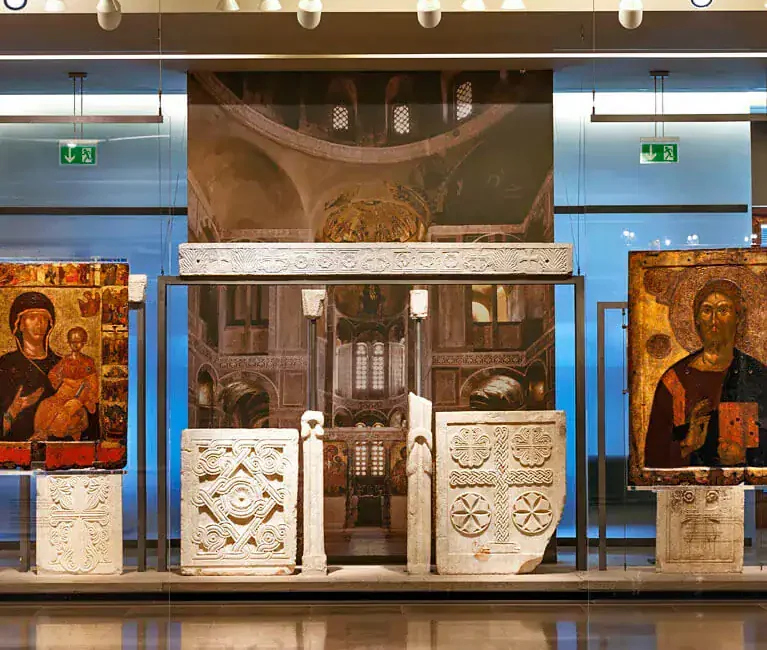
Icons, mosaics, sculptures, manuscripts and ecclesiastical treasures guide visitors through this remarkable era, illustrating how faith and art became inseparable pillars of Byzantine identity.
From Byzantium to the Modern Greek Era
The second part of the exhibition explores the centuries following the fall of Constantinople in 1453. As Byzantine territories gradually diminished, new social and political realities emerged across the Eastern Mediterranean.
In Venetian-controlled regions such as Crete, the Ionian Islands and the Cyclades, Byzantine tradition encountered Western Renaissance influences, giving rise to new artistic movements. The blending of cultures produced works that reflect both continuity and adaptation — a testament to Hellenism’s resilience.
Villa Ilissia: A Palace of Elegance
The museum is housed in the magnificent Villa Ilissia, completed in 1848. Once the residence of Sophie de Marbois-Lebrun, Duchess of Plaisance, the building is a striking example of neoclassical architecture infused with Romantic elements.
Since 1926, the villa has served as the permanent home of the museum, its stately façade and symmetrical wings offering a serene contrast to the vibrant city surrounding it.
An Oasis in the City
Beyond its galleries, the museum’s gardens provide a peaceful retreat in central Athens. Shaded pathways, fountains and aromatic plants create an atmosphere of calm reflection. Visitors can also explore three themed outdoor displays dedicated to Athens’ historic water systems, the Byzantine concept of Paradise and the River Ilissos.
A charming café-bistro nestled within the grounds offers the perfect spot for coffee or a light meal under the Attic sky.
A Cultural Must-Visit
For travellers seeking to understand the spiritual and artistic foundations of Greece, the Byzantine and Christian Museum is an essential stop. It bridges centuries of history, connecting ancient heritage with the living traditions of modern Hellenism.
Whether you are a history enthusiast, an art lover or a curious visitor to Athens, this remarkable institution promises an unforgettable journey through time.
6 Overlooked Unique Experiences In Athens
Tags:
Athens, Athens cultural attractions, Athens museums, Byzantine and Christian Museum, Byzantine art Greece, Byzantine Empire history, Constantine the Great, Greek, Greek culture, Greek heritage, greek news now, museums in Greece, post-Byzantine art, Things To Do In Athens, Villa Ilissia


0 Comments