
How a Shaved Head Sparked the Wars Between the Ancient Greeks and Persians

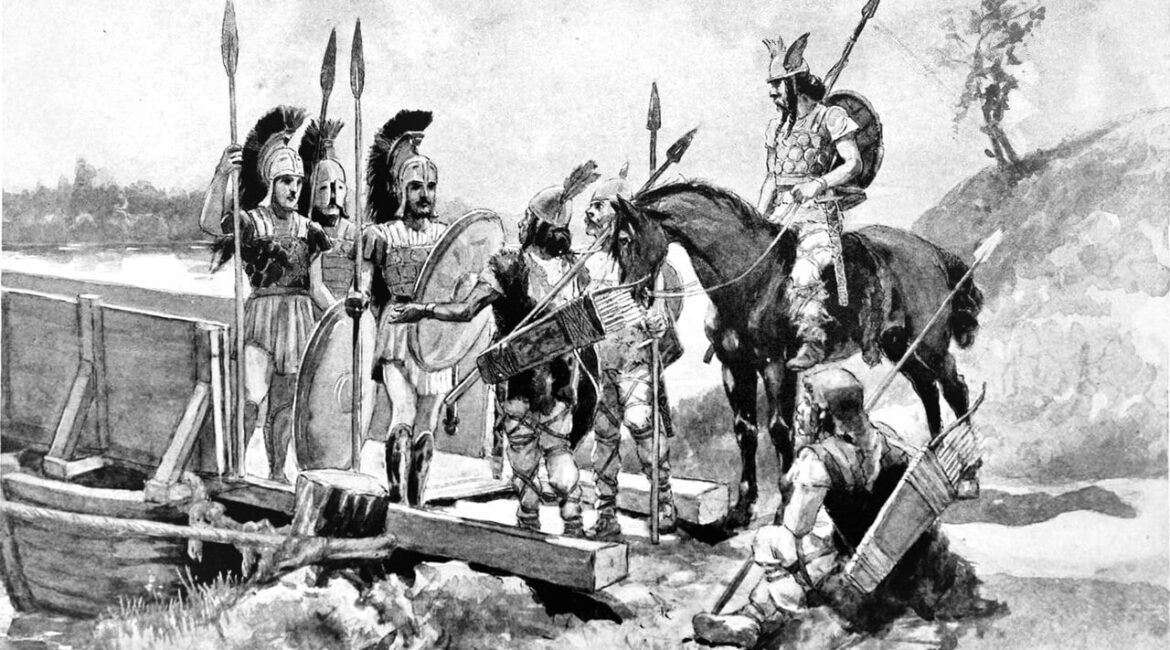
The Greeks under Histiaeus preserved the bridge of Darius I across the Danube River. 19th-century illustration. Credit:
The story of Histiaeus and the Ionian Revolt, which would ultimately help set the stage for the wars between the Ancient Greeks and Persians, is a historical footnote that illustrates how the most effective secrets are often hidden in plain sight, sometimes altering the course of history through a single ingenious act.
In 499 BC, the Mediterranean was a region of mounting tension, as the Persian Empire tightened its grip on the Greek city-states of Ionia along the western coast of present-day Turkey.
Histiaeus, the former tyrant of Miletus, was living in a state of honorable captivity in the Persian capital of Susa. During the late 6th century BC, he had ruled Miletus under the authority of Darius I of the Persian Empire. A shrewd and opportunistic leader, Histiaeus earned the Persian king’s favor by guarding the bridge over the Danube during Darius’s campaign against the Scythians, an action that effectively spared the Persian army from disaster. Yet his rising influence and his fortification of a strategic site in Thrace aroused suspicion. As a result, Darius “honored” him with a permanent, closely supervised residence at the royal court in Susa.
Histiaeus and the road to the Greco-Persian Wars
Although he enjoyed the luxury of the royal court, Histiaeus was politically marginalized and longed to return to the Aegean, where he had first risen to prominence in the world of Ancient Greece. To accomplish this, he devised an unorthodox strategy: provoke a conflict significant enough to compel King Darius to send him back, where he could maneuver to restore order and reestablish himself as the unrivaled leader of the region.
This insurrection was rooted in the oppressive structure of the Persian satrapies. Histiaeus believed that by encouraging instability, he could present himself as the only capable local authority able to quell the unrest, thereby reclaiming his former power.
The cunning plan of Histiaeus
The intended recipient of this perilous message was his son-in-law, Aristagoras, who was serving as deputy tyrant of Miletus. Already disgraced after a failed expedition to Naxos, Aristagoras was contemplating a break from Persian rule. The arrival of Histiaeus’ message would provide the decisive push toward open revolt.
To evade the extensive Persian relay system and the vigilant guards stationed along the Royal Road, Histiaeus employed a primitive form of steganography. He selected a loyal slave, shaved his head, and tattooed the call to rebellion directly onto his scalp. The slave remained in Susa until his hair had fully grown back, completely concealing the inscription. Once the message was hidden beneath a thick head of hair, he traveled undetected to Miletus, as no one would suspect a slave of carrying instructions to incite revolt in another part of the Empire. Upon arrival, he told Aristagoras to shave his head, thereby revealing the command to spark the Ionian Revolt.
This concealed message altered the course of history. Aristagoras embraced the call to action and declared Ionia’s independence. He then led the rebels in a campaign that drew support from Athens and Eretria, as fellow Greeks from across the Aegean sought to expand their influence eastward. Although the Persian Empire eventually crushed the uprising with its superior numbers and resources, the conflict became the direct catalyst for the Greco-Persian Wars. The burning of Sardis during the revolt enraged Darius and fueled a vendetta against the Greeks that culminated in the historic battles of Marathon, Thermopylae, and Salamis.
The story concludes with dark irony. Histiaeus initially achieved his objective when Darius dispatched him to the coast to address the crisis. In time, however, the Persian king uncovered the deception. Histiaeus was captured, executed, and his head was displayed before the king.
His ingenuity helped unleash a conflict that reshaped the Ancient Greek world and altered the balance of power in the Eastern Mediterranean, yet it ultimately led to his own destruction.


0 Comments