
Ancient Olympics Barred Women, But Greek Girls Still Raced

Women rarely competed in the ancient Olympic Games, and authorities largely barred them from even attending, according to an explainer by Owen Jarus, published on LiveScience.com.
The Olympics ran from about 776 B.C. to A.D. 393 and attracted competitors from across Greece and beyond. For much of that time, restrictions against women remained strict. The ancient writer Pausanias, who lived in the second century A.D., described a law that punished women caught at the Games by throwing them off a cliff.
However, Jarus noted that women and girls still found athletic opportunities in ancient Greece—especially in running. He highlighted the Heraea, a series of footraces held at Olympia in honour of the goddess Hera. Pausanias wrote that the competition involved unmarried girls, divided into three age categories, and took place every four years.
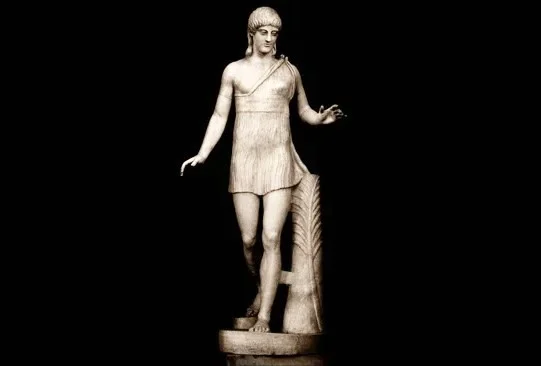
Pausanias also described how the runners dressed, saying they let down their hair, wore a tunic that hung just above the knee, and exposed the right shoulder. Jarus noted that ancient Greek artefacts depicted women dressed this way while engaging in athletic activity.
A 2,500-year-old statuette of a female who appears to be preparing to run. She wears a chiton (a short dress) that matches those described in ancient texts. (Image credit: Hulton Fine Art Collection/Getty Images)
Victors received olive crowns and a share of a cow sacrificed to Hera, Pausanias wrote, and winners could also set up statues bearing their names. Jarus added that similar female footraces occurred at other Greek sites.
Women also entered chariot teams into major competitions, including the Olympics, Jarus reported. Although women did not necessarily drive the chariots, they could still claim victory as the team’s owner. Jarus pointed to Kyniska, the sister of a Spartan king, who became the first known female Olympic victor when her chariot team won in 396 B.C. An inscription described her as the “only woman in all Greece” to win the Olympics.
Jarus also cited evidence suggesting women participated in other sports, including wrestling. Heather Reid, professor emeritus at Morningside University, told Live Science that literary sources indicated women—especially in Sparta—practised activities like wrestling for educational purposes.
In Sparta, young women trained in wrestling and other sports to build and maintain muscle. Jarus noted that the Roman-era poet Propertius described his surprise at seeing a naked girl take part in games among male wrestlers without criticism. He also wrote that Spartan women practised pankration, an ancient form of mixed martial arts.
After marriage, opportunities for women appeared to shrink, Jarus reported. Reid told Live Science that women’s athletics often related to rites of passage, particularly the transition from childhood to marriageable age. Still, Georgia Tsouvala, a history professor at Illinois State University, said married women in Sparta may have competed in local events and continued using gymnasiums and wrestling schools even after marriage and pregnancy.
Jarus reported that female athletic competitions appeared to increase during the Roman control of Greece, which began in the second century B.C. More records mentioned women’s footraces during this period, although scholars said the reasons remained unclear. Onno van Nijf, an ancient history professor at the University of Groningen, told Live Science that researchers had not yet established a clear explanation for the shift.
Jarus also referenced Roman-era inscriptions that recorded female athletes. One inscription described a woman named Hedea, who won multiple footraces and chariot races in the first century A.D. and received Athenian citizenship for her victories. Another inscription from the island of Kos listed members of a wrestling school and included a woman named Hetereia Prokilla, whose status suggested she may have belonged to the elite.
One of the most famous surviving depictions of a female athlete came from the Roman era, Jarus noted. The “Vatican runner”, dating back around 2,000 years, showed a young woman wearing a chiton and appearing to run a race. The artwork is now housed in the Vatican Museums.
Photo of a statue of a woman in a jogging posture. She is depicted in bare feet and wearing a short dress. The “Vatican runner” or “Atalanta Barberini” depicts a Greek female wearing a chiton (a short dress) who appears to be running. It dates back around 2,000 years. (Image credit: Peter Horree/Alamy)
Tags:
ancient Greece, archaeology, chariot racing, Greece news, Greek City Times, Greek news, Heraea, Kyniska, olympics, Pausanias, Roman Greece, Sparta, Women in sport, wrestling


0 Comments