
Greek school: Language or identity?

A new year and a new school year. For 2026 Melbourne’s Greek community is braced for a familiar challenge. At the front line are the children of our Greek schools — young faces carrying the weight of a language and a cultural legacy that refuses to disappear.
In the age of AI, everything moving at dizzying speed it is heartening to see that many families still choose Greek school for their children. That choice, however, deserves more attention.
Who are today’s Greek school families?
Some children come from two Greek-Australian parents. A smaller number have parents who migrated from Greece in the last decade or so. Most come from mixed families — where one parent is Greek (often second, third, or even fourth generation) and the other is not. At least 30–40 per cent of students in Greek schools come from mixed marriages.
Despite these differences, one reality is striking: when children begin Greek school, their level of Greek is largely the same — beginner level — with only a few exceptions where the language is spoken at home. And, many children of Greek background never attend Greek school at all, or leave after a short time. That fact alone should give us pause for concern.
What do parents really want?
What are parents looking for when they send their child to Greek school? What does a modern child need in order to feel drawn to a school? And what does “Greek school” mean for a child of the third, fourth, or fifth generation?
To answer these questions , one needs years of experience in diaspora education, an understanding of how needs change across generations, and a realistic view of today’s world.
A Greek school must first and foremost be a place of warmth, care, and belonging. A space of acceptance, positivity, joy, and support — where children feel safe, valued, and welcome. It should be a place where they build friendships, discover their roots, and develop identity, confidence, and self-respect.
When a child feels comfortable, happy, and connected to the school community — when they feel that they belong — language learning follows more naturally. Fluency grows in an atmosphere of trust, not pressure.
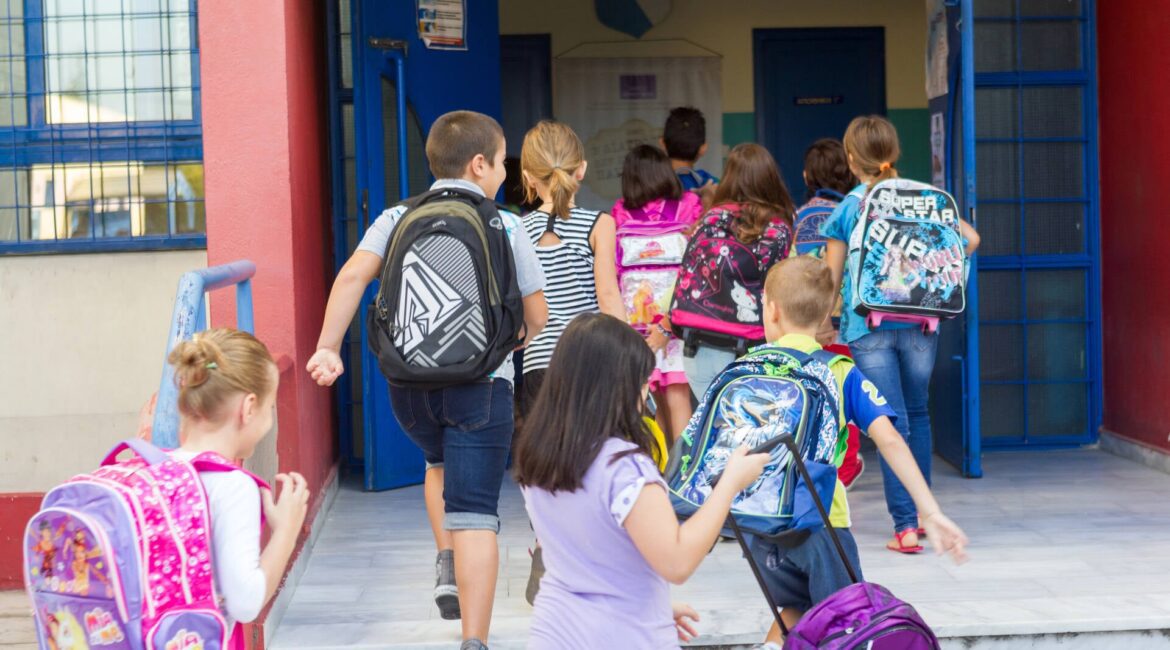
A Greek school classroom as a space of belonging — where children don’t just learn a language, but begin to recognise who they are and where they come from. Photo: Depositphotos
The role of leadership and teachers
A school’s success depends directly on its leadership and the quality, training, and experience of its teachers. No curriculum can compensate for a cold environment, and no technology can replace genuine human connection.
Why learning Greek is harder today
In recent years, it has become painfully clear that learning Greek is far more difficult for younger generations than it once was. Many children have little or no exposure to Greek outside school hours. Their daily lives are shaped by English, digital media, and a global culture that often pulls them away from their heritage.
Families are busier than ever. Most parents work long hours, and many simply do not have the time — or the language skills — to help with Greek homework.
In most Greek schools, children are not given formal homework. That means the responsibility falls almost entirely on the school and its teachers. When homework is assigned, it must be clear, simple, and designed so that the child can complete it independently — knowing that parents may not be able to assist.
Language or identity?
The real priority
For most parents, the goal is not just language acquisition. What they value just as much — if not more — is identity, friendship, and a sense of community. They want their child to be in a friendly, safe environment where they can communicate, create, enjoy themselves, and feel that they matter.
This must be the school’s core mission. At the same time, schools should challenge advanced students to reach their full potential, while patiently supporting those who are struggling but willing to try.
A last chance — and a new hope
As we watch the gradual erosion of Greek in the diaspora, and acknowledge — with sadness — that many children of Greek heritage will never step inside a Greek school, we must protect what we still have.
Let us embrace the children who choose to come. Let us teach them with conscience, realism, and respect for their pace. Let us allow them to approach the language steadily, without unrealistic expectations that they will learn as earlier migrant generations did.
This may be the last generation we can truly keep close to our roots. We cannot afford to lose them.
And yet — on the horizon, something new is emerging. A more confident, more self-aware wave of Greek-Australians who take pride in their heritage. A generation that moves between cultures with ease, that claims its Greek identity not as a burden, but as a source of strength.
That gives us hope. And it reminds us why this fight — for language, for identity, for belonging — still matters.
*Andria Garivaldi is Principal of Zenon Greek School


0 Comments