
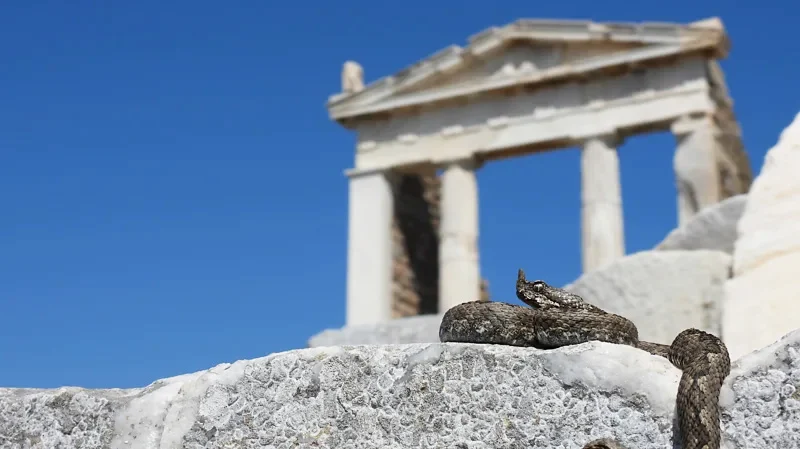
Ancient Greek Sites Serve as Unexpected Havens for Wildlife

Archaeological sites across Greece are proving to be inadvertent sanctuaries for wildlife, sheltering thousands of species from the pressures of urbanization, agriculture, and climate change reports the BBC.
A recent study by the National and Kapodistrian University of Athens, conducted as part of the Greek government’s Biodiversity in Archaeological Sites project, surveyed 20 historic locations ranging from prehistoric settlements to Byzantine cities. Researchers documented 4,403 species, representing roughly 11% of Greece’s known biodiversity within just 0.08% of the country’s land area.
“Archaeological sites are more than just ruins; they function as stable landscapes that protect both cultural heritage and wildlife,” said Panayiotis Pafilis, professor of animal diversity and lead researcher of the study. Animals such as endemic lizards in Mystras, rare orchids near Etruscan necropolises, and a potential new snail species in Delphi have all found refuge within these protected sites.
Special protections and restricted development make ancient sites valuable for conservation (Credit: BIAS Photographic Archive/ Natural Environment and Climate Change Agency)
Plants also benefit from these “arks,” despite occasional management practices like vegetation trimming. Botanist Theophanis Constantinidis highlighted the importance of selective vegetation control to enhance biodiversity without compromising the archaeological sites themselves. Some plants, like centuries-old oaks in Dodona or poison hemlock near historical locations in Athens, demonstrate continuity with the region’s cultural and mythological past.
The initiative, supported by the Greek Ministry of Culture, the Ministry of Environment, and the Natural Environment and Climate Change Agency, aims to highlight the dual value of historic sites for both heritage preservation and ecological protection. In addition to the Greek findings, similar results have been reported in Italy and Peru, where ancient ruins provide critical habitat for endangered geckos and other species.
Experts stress that collaboration between archaeologists and biologists is essential to manage these sites effectively. By integrating biodiversity goals into site management, cultural landmarks can simultaneously act as conservation zones, contributing to global targets to protect 30% of ecosystems by 2030.
“These sites are transforming into arks of biodiversity,” said Greek Culture Minister Lina Mendoni. “Preserving history and nature together demonstrates the deep connection between humanity and the natural world over millennia.”
The Delos viper has made ancient sites in Greece its home (Credit: BIAS Photographic Archive/ Natural Environment and Climate Change Agency)


0 Comments