
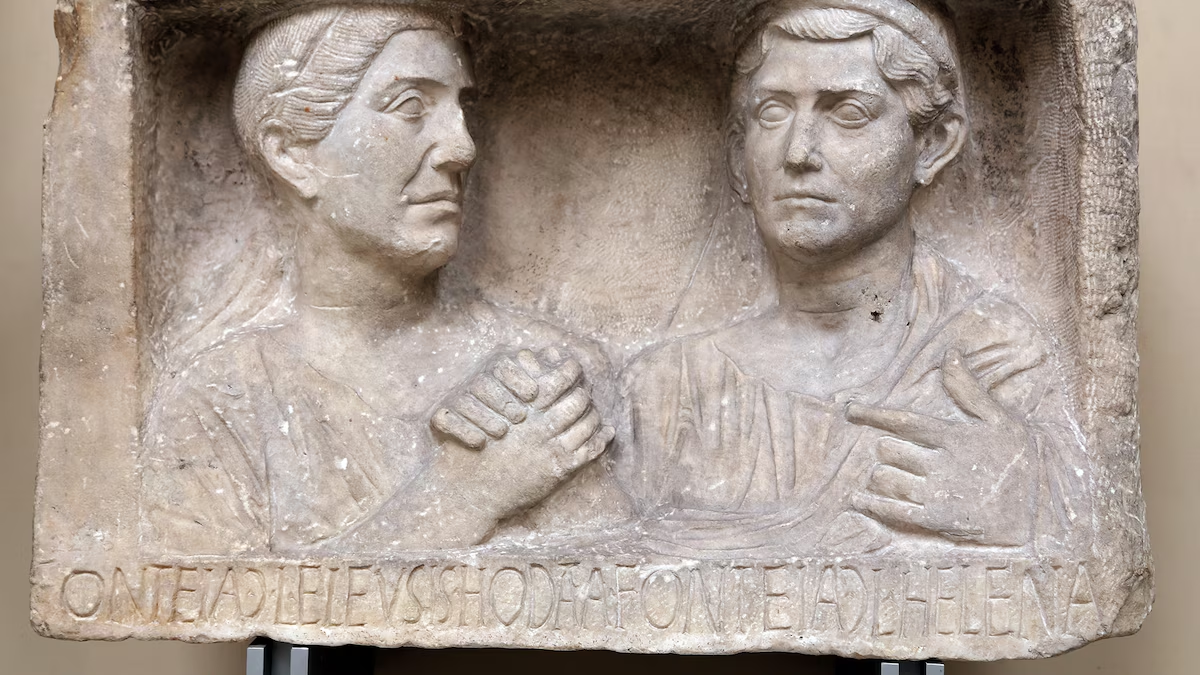
Did the ancient Romans really abandon people with disabilities?

The find is interesting, because it is the first discovery of earthquake victims at the site. Anthropological analysis of the human remains, some of which were only partially intact, revealed that some of the deceased individuals had a congenital malformation. Using the methods of osteobiographic reconstruction pioneered by Saul and Saul and developed by others like Lauren Hosek and John Robb, the authors of the study determined that all the individuals (with one possible exception where the skeleton was badly damaged) “were likely of the male sex.” Two of the individuals were younger (18–20), while the remainder were older, between 25 and 35 years old at the time of death.
(This carpenter builds crutches for kids. Now it’s his turn to walk.)
Anthropological examination revealed that one of the younger individuals (2N) “suffered from a serious condition.” One of the other individuals trapped in the cistern seemed to have had a cleft palate. The remains of individual 2N revealed “a variety of pathological features” that were severe on their own but, when found in conjunction, are suggestive of the rare genetic disorder Apert syndrome. Apert syndrome causes the joints in the skull to close early, leading to atypical bone formation in the face, feet, and hands. These differences would have been apparent from birth and may have led to difficulties with feeding, breathing, possible hearing problems, speech impediments, and even blindness. It is unlikely, Russeva and Manoilova write, that this young man would have been able to work, and he may have been vulnerable to ridicule because of his bodily differences. “Applying modern designations, this individual would be considered a person with disabilities,” and would have been highly dependent upon others, they conclude.
You May Also Like
The location of the six remains in the cistern suggested to the authors of the study that the small group was attempting to escape the earthquake when they died. “It is possible,” they write, “that one of the other earthquake victims found in the cistern was accompanying and trying to help the disabled person survive the disaster.” Though the study only considers a small sample of people, it challenges modern assumptions about the value of people with disabilities in the ancient world.
Caring for babies with bodily differences
What then of the ancient Greeks, who, according to Plutarch, would surely have dispensed with disabled infants like this? Here again, both the archeological and literary evidence suggests something different. In an article published in Hesperia in 2021, Debby Sneed argued that there is widespread evidence that “ancient Greek parents, midwives, and physicians often took active and extraordinary measures to assist and accommodate infants born with a variety of congenital and physical impairments.”


0 Comments