
Greece Didn’t Exist 1300 Years Ago?

By Bill Giannakopoulos
Athens, Greece – November 25, 2025
In a bold and baffling display of historical amnesia, Turkey’s Ambassador to Tajikistan, Umut Acar, has ignited a firestorm of criticism after mocking the enduring Greek presence in Anatolia on social media. His flippant remark – implying that “Greece didn’t exist 1300 years ago” – has been slammed as yet another chapter in Turkey’s ongoing campaign to erase the millennia-old Hellenic footprint from the lands once known as Ionia, Lydia, and the heart of Byzantium.
GREECE DIDNT EXIST 1300 YEARS AGO
ACCORDING TO 🇹🇷 AMBASSADOR
In Turkey history isn’t taught, it’s curated like a TV series starring Ataturk in every episode.
The latest masterpiece comes from Turkey’s ambassador to Tajikistan, who confidently declared that “Greece didn’t exist… pic.twitter.com/6v05jPlGXl
— Harry Theocharous (@TheocharousH) November 24, 2025
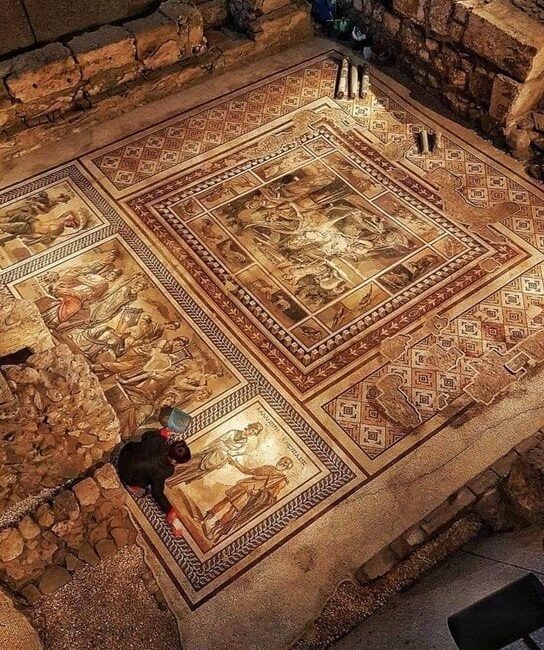
The controversy erupted earlier this week when archaeologist and historian @archeohistories shared breathtaking images of a 1,300-year-old mosaic discovered in Antakya (ancient Antioch), a city founded by Seleucus I Nicator in 300 B.C. as a beacon of Hellenistic culture. The post celebrated Antioch’s legacy as a thriving Greek metropolis, a crossroads of philosophy, trade, and early Christianity that outshone even Alexandria in its prime. Renowned Greek author and philosopher Homer Pavlos (@HomerPavlos) couldn’t resist a wry observation: “In Turkey, no matter which stone you lift, you’ll find a Greece underneath it.”
Ambassador Acar’s response? A casual shrug emoji and the line: “This guy actually believes Greece did exist 1300 years ago. 🤷🏻♂️” Posted on November 23, the diplomat’s tweet – which he clarified as a personal view – quickly went viral, drawing sharp rebukes from the Greek diaspora and history buffs worldwide.
2nd-century AD “Pegasus” (or “Helikon”) mosaic from the Antakya Museum Hotel in Turkey (ancient Antioch). This is part of the world’s largest intact ancient mosaic floor, dating to around 150–200 AD, depicting mythological scenes inspired by the Muses, Pegasus, and the Hippocrene spring on Mount Helicon—symbols of poetic inspiration from Greek lore.
Leading the charge was Cypriot aviation expert and commentator Harry Theocharous (@TheocharousH), whose viral thread on November 24 dissected the ambassador’s ignorance with razor-sharp wit. “GREECE DIDN’T EXIST 1300 YEARS AGO ACCORDING TO AMBASSADOR,” Theocharous blasted, before unleashing a scathing takedown of Turkish education: “In Turkey, history isn’t taught, it’s curated like a TV series starring Ataturk in every episode.”
Theocharous didn’t hold back, painting a vivid picture of a curriculum that glorifies Turks as the inventors of “everything from bread to the wheel,” while reducing ancient Greeks to mere “temporary Airbnb guests” in “Western Anatolia.” He reminded followers of the Byzantine Empire’s glory – the Greek-speaking, Orthodox Christian successor to Rome, with Constantinople as its glittering capital – which was at its zenith precisely 1,300 years ago, long before the Seljuk Turks arrived in Anatolia around 1071 A.D., some 400 years later.
“Greece existed 1300 years ago and exists, speaks Greek and has been there for literal millennia,” Theocharous concluded. “Don’t forget, Turks only showed up in Anatolia 400 years later.” His post, complete with a screenshot of Acar’s tweet, has exploded with over 700 likes, 100 replies, and 50,000 views in under 24 hours, resonating deeply with Greeks proud of their unbroken heritage from Homer to the present day.
Unearthing the Truth Beneath the Mosaics
This isn’t just a Twitter spat; it’s a microcosm of the cultural erasure Greeks have long accused Turkey of perpetrating. Antioch, with its Greek inscriptions, theaters, and basilicas, was a cornerstone of the Byzantine world under emperors like Justinian I, whose Code of Roman Law – penned in Greek – shaped Western civilization. The city’s fall to Arab invaders in 637 A.D. was a blow, but Hellenic influence endured until the Ottoman conquests centuries later.
Pavlos followed up with a mix of pity and punch: “You can’t be mad with them. Turkey is a 3rd world country. The education system they have is one of the worst in the world.” He even noted the irony of Acar’s “Greek” features, a nod to the ethnic mosaic of modern Turkey. Echoing the sentiment, user @damasus01 retorted: “He is too illiterate or cannot stop lying – as Greece existed even long before. Has he ever heard of Athens… Sparta… the great philosophers?”
A few pedants pointed out a technicality: “Greece did not exist 1300 years ago. GREEKS did exist, but the nation-state of Greece did not. It was the Byzantine empire… Greece was established in 1830.” Fair enough – but as any philhellene knows, “Hellas” has pulsed through Anatolia’s veins since Mycenaean times, from the Trojan War to the libraries of Pergamon.
Echoes of a Deeper Rift
This dust-up comes amid simmering Greek-Turkish tensions over Cyprus, the Aegean, and maritime boundaries, where history is weaponized as readily as rhetoric. Turkish textbooks have drawn fire for “Turkifying” the past, downplaying the legacies of Greeks, Armenians, and Assyrians in favor of a narrative that begins with the Ottomans as benevolent unifiers. Acar’s quip, though off the cuff, feeds into this script, prompting calls for diplomatic accountability.
As of press time, Acar has stayed silent, and Turkey’s Foreign Ministry has offered no response. But for Theocharous and countless others, the silver lining is clear: “At least now people are talking about real history.” In a world quick to forget, every unearthed mosaic and every viral thread is a defiant shout – We were here. We are here. And we always will be.
Tags:
antioch mosaic, Athens, byzantine empire, Greece, Greece news, Greek, Greek history, Greek news, greek news now, greek news today, Greek Turkish relations, Hellenic legacy, historical revisionism, Turkey, Turkish ambassador, umut acar


0 Comments