
Roman Mosaic Discovery in Ancient Nicaea Reveals Personification of Lake Ascania

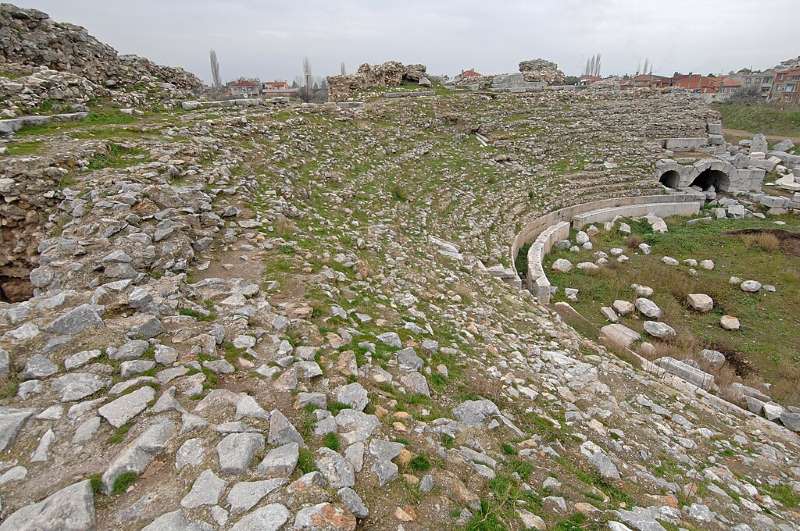
Ancient Greek city of Nicaea. Credit: Wikimedia Commons / Dosseman / CC BY 4.0
A vivid Roman mosaic has been uncovered in İznik, Turkey—the site of the ancient Greek city of Nicaea (Greek: Νίκαια). The find lay hidden beneath a quiet residential street for more than a decade and is now reshaping scholarship on the city’s Greco-Roman heritage and its symbolic ties to the surrounding landscape.
The mosaic first emerged in 2014, when sewer workers in Beyler Mahallesi exposed part of a face crafted from colored stone tesserae. Authorities halted construction immediately, but expropriation and excavation approvals took years.
The İznik Museum Directorate launched a full archaeological investigation only in 2024, transforming an accidental discovery into one of the most significant finds linked to ancient Nicaea.
Detailed 3rd-century floor reveals Nicaea’s Roman identity
As layers of soil were removed, archaeologists uncovered a 50-square-meter (538 square feet) stretch of mosaic flooring in striking condition. Ceramic fragments and coin evidence date the structure to the 3rd century AD, a period when Nicaea was a major cultural, administrative, and religious center of the Eastern Roman Empire.
Experts believe the mosaic decorated an elite residence, a public structure, or possibly a Roman bath complex, given its refined workmanship and thematic references to water—an element central to Nicaea’s mythology and geography.
📍 Bursa’nın İznik ilçesinde, 11 yıl önce kanalizasyon çalışması sırasında fark edilen taban mozaiği, bu yıl başlatılan arkeolojik kazılarla gün yüzüne çıkarıldı.
Yaklaşık 50 metrekarelik mozaik, Roma Dönemi’ne tarihleniyor ve bir kamu binası, lüks villa ya da hamam yapısının… pic.twitter.com/EtpUV5gcnS
— arkeolojihaber ® (@arkeolojihaber) November 20, 2025
Three large panels form the core of the design, framed by a border of pomegranate and ivy motifs, symbols of fertility, continuity, and divine protection that were widely used across Greek and Roman art. The tesserae remain bright and tightly set, offering a rare example of high-quality floor mosaics surviving within Asia Minor, also known as Anatolia.
Mythological scenes reflect regional Greek traditions
One panel depicts a goddess of abundance holding a basket of fruits believed to represent produce traditionally cultivated around Lake İznik Lake Ascania pointing to the region’s long agricultural continuity.
Additional mythological figures and partially preserved inscriptions offer new material for epigraphic study, potentially shedding light on how Greek and Roman mythologies blended in Nicaea during late antiquity.
Central panel reveals Lake Ascania as an ancient woman
The most striking feature appears in the central panel: a serene female portrait labeled “Askania,” the ancient Greek name for Lake İznik. The lake was known in Greek and Roman times as Lake Ascania (Greek: Ἀσκανία), a name widely used in classical texts.
Lake Iznik, present-day Turkey. Credit: Cetintas555 / Wikimedia Commons / CC BY-SA 4.0
Her hair flows like underwater vegetation, her crown is crafted from crab claws, and soft, wave-like lines shape her neckline. The symbolic details present the lake not as scenery but as a living deity—an artistic tradition deeply rooted in Greek culture, where rivers, springs, and lakes were often personified as female nymphs or local guardian spirits.
Archaeologist Yusuf Kahveci highlighted the significance of the portrayal, saying, “They depicted Lake İznik as an ancient woman.” The panel suggests that Lake Ascania held spiritual or protective meaning for the people of Nicaea, echoing classical Greek beliefs in nature deities who shaped the identity of a city and its surroundings.
Layers reveal continuous life from Greek Nicaea to the Ottomans
The excavation also shows that the site remained active long after the Roman period. Structural remains from the 4th, 5th, 8th, 10th, and 11th centuries appear above and below the mosaic. Byzantine floors and walls survive in the southern section, while early Ottoman ceramics in upper layers reveal continued use through the 15th and 16th centuries.
This uninterrupted stratigraphic record offers a rare window into the long urban life of Nicaea—a city central to Greek, Roman, Byzantine, Seljuk, and Ottoman history.
Evidence suggests a much larger Greek-Roman complex
Archaeologists have excavated about 350 square meters (~3,767 square feet) of the site, but clues indicate that the mosaic extends far beyond the exposed section. A pair of sandal motifs found near a threshold point to a monumental entrance, suggesting that additional rooms or panels remain hidden beneath modern structures.
A major contribution to the understanding of ancient Nicaea
Researchers plan further excavation phases to determine the building’s full extent and original purpose. For now, the personification of Lake Ascania stands as one of the most striking artistic discoveries linked to ancient Nicaea in recent decades.
Experts say it illuminates how Greek and Roman communities embedded mythology, geography, and civic identity into their public and private spaces—offering a rare and vivid connection to the spiritual landscape that shaped life in one of antiquity’s most storied cities.


0 Comments